Limited Edition Information
| Wolves of the Calla |
|---|
|
|
Publication Information
Limited Edition Information |
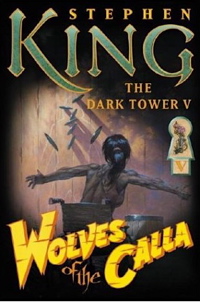
This fifth book of King's Dark Tower series is the first to not feature Roland the gunslinger in its opening pages - the first of many stylistic and character changes in this long novel. Following King's initial "Argument" (in which he recounts the major points of the Dark Tower series thus far), we are introduced to the small town Calla Bryn Sturgis. There, we learn the horrible plight of its folken: every twenty-three years or so, harriers known as Wolves ride in from the foreboding land of Thunderclap to steal the townsfolk's children, one half of the many pairs of twins populating the town. When the twins are returned (aboard a train, another recurrence of the Blaine/Charlie the Choo-Choo iconography) they are changed; roont, in the parlance of the Calla. They return to the Calla as idiot hulks, and later die sudden, painful deaths.
At this point, we resume the primary story of our ka-tet: Roland Deschain, Eddie and Susannah Dean, Jake Chambers, and little Oy, the billy-bumbler. Roughly two months have passed since the ordeal at the Emerald Castle in Wizard & Glass, and those months have brought change. Jake, fast approaching adulthood, is becoming as natural a gunslinger as Eddie and Susannah had been. Susannah is changing, too, and not for the better: the conflict of her multiple (and merged) personalities reasserts itself. A fourth personality, a woman named Mia (meaning mother), has emerged, and is hungry. As a consequence of the demon rape Susannah endured (and used) to bring Jake into their world, she is now pregnant, and the child is not human.
The townsfolk of Calla Bryn Sturgis encounter Roland's ka-tet and ask for help to stand against the Wolves. It is here that King's allusions first become evident. Just as the finale of Wizard and Glass had seemed an alarmingly exact retelling of the film Wizard of Oz, here the situation of Wolves of the Calla so closely mirrors events of Akira Kurosawa's The Seven Samurai (later adapted as a Western known as The Magnificent Seven, directed by none other than John Sturges; Eddie even makes this connection in the text) that words like homage and pastiche don't seem strong enough. At various points in the novel, King borrows from Star Wars, Marvel Comics, and the Harry Potter series, going so far as to utilize the title font from those books in Wolves.
Nor does King borrow exclusively from the works of others: in Calla Bryn Sturgis, the ka-tet meet the Father Donald Callahan, last seen years ago escaping the town of 'Salem's Lot in that eponymous novel. Callahan's alcohol-soaked tale of his travels from Maine to Calla Bryn Sturgis demands a large portion of the book, but remains largely captivating (especially the notion of flipping, last discussed in The Talisman). Still, here as elsewhere in Wolves, one gets the sense that some judicious editing might have served the story well. While it is exciting to follow Callahan's history and to revisit the world of 'Salem's Lot to a degree, he seems largely superfluous to the story ... until the book's final pages, during which King's larger intentions for the Dark Tower series become clearer.
Wolves follows dual storylines: the steadily marching threat of the Wolves out of Thunderclap, and the larger, more insistent threat to the lone rose in New York City, which is an analogue to the Dark Tower itself. This flower Jake first glimpsed in The Waste Lands is seen again, felt again, here, and by more of the ka-tet. The doors between worlds so important to The Drawing of the Three and The Waste Lands reappear here, as well as a form of traveling known as todash - the way the ka-tet traveled into Roland's past in Wizard and Glass. A way of existing in a parallel world without physically appearing, the ka-tet travel todash in their dreams, and it is while in this state that they learn that the danger to the rose more imminent than any had guessed. Here, King draws on the back stories of the New York members of the ka-tet, further exploring chance meetings and acquaintances of Jake and Eddie from the earlier books in the series and making formerly tertiary characters major players. As Susannah states early in the novel, "coincidence has been canceled"; this theme comes to define this final three novels of the series.
King writes in his Afterword to Wizard & Glass that "...Roland's world (or worlds) actually contains all the other of my making." While Eddie mentions the film version of The Shining and references to The Stand appear in The Waste Lands and Wizard & Glass, it is here that King begins asserting these connections. The lost-pet posters from Hearts in Atlantis are mentioned, and the real-life phenomenon of the Richard Bachman pseudonym is referenced. The intervals between the Wolves' arrivals coincide with the waking/feeding periods of It. Eddie even makes a throwaway comment suggesting a certain scene in King's Misery. This is all before Stephen King is referenced specifically, when a physical copy of the novel 'Salem's Lot appears, raising questions about Callahan's reality, and the structure and intent of the Dark Tower series as a whole.
There is a lot going on in Wolves of the Calla, perhaps too much. In addition to the business with the Wolves and the storyline about the rose, we are also contending with Susannah's pregnancy, Jake's coming-of-age story, Roland's arthritis, folk tales and religion, a betrayal and treachery among the folken, and King's overarching theme of storytelling and its importance. These various aspects of Wolves mesh well - in the way that King has easily merged various genres throughout the series - but with so much to cover, the novel has a tendency to get bogged down in details. King has a tendency to over-utilize the local patois; though it serves to make the people of the Calla more three-dimensional, the accents, slang, and unique verbiage are at times exasperating, and might have been used more judiciously, as in Dolores Claiborne. The opening sections of Wolves of the Calla are among King's densest fiction, requiring concentration and determination on the reader not necessary in any of the other books of the series, and rarely in King's fiction as a whole (with the exceptions of The Talisman and Black House).
Additionally, Wolves introduces a storyline that would feel more at home in a corporate thriller, featuring discussions of dummy corporations and compounding interest. While it makes sense in the context of the novel (and will become vital to the series as a whole), it disrupts the flow of the story, gelling imperfectly with the other facets of Wolves.
Further, the sudden intrusion of the number nineteen is at turns interesting and distracting. While King's revision of The Gunslinger introduces the importance of the number earlier in the series, the initial reference to the number in Wolves is abrupt and puzzling. Its subsequent appearances repeat with such a frequency that it feels as if King is insisting that it matters, rather than it feeling organic to the story, as "coincidence has been cancelled" does. (Though, given King's later appearance in the series, one could argue that that was indeed the intent.)
The book's drawbacks resolve themselves in the final third. The pacing, which is slow at the start and steady in the middle, suddenly accelerates, taking on the urgent momentum of Firestarter or The Girl Who Loved Tom Gordon. Early in the novel, both Eddie's and Jake's personalities seem wildly different from what we've seen in the previous four novels; if it's character growth and change, it feels rushed. When the book settles into its rhythms, their new character traits and growth seem more natural. The finale - in which the ka-tet and the townspeople of Calla Bryn Sturges face off against the Wolves - is one of King's most intense action sequences, recalling the apocalyptic rockfight in It and the final showdown between Thad Beaumont and George Stark in The Dark Half.
Where Wolves of the Calla mainly succeeds is in its functionality. It neatly sums up the important themes of the first four novels and forwards those of the final two. Like The Drawing of the Three and The Waste Lands, it draws another member into the ka-tet - Father Callahan, whose mission of redemption is key to his character and the success of the series. It introduces storylines that will flow through the final books of the series, making these last three books read like a trilogy within the series.
Unfortunately, while the story of the Calla and the Wolves is interesting and involving, it never seems vital to the larger series as a whole. The Gunslinger introduced the Dark Tower and Roland, The Drawing of the Three brought together the ka-tet, The Waste Lands drew Jake from our world and forwarded the quest for the Tower significantly, and Wizard & Glass revealed Roland's history. Against the backdrop of the search for the Dark Tower, all of these more immediate storylines are necessary, engaging facets of the series; in comparison, the story of the Wolves simply seems less important, especially given to the novel's larger concerns.
Though Wolves of the Calla is a good book, it never achieves the resonance or significance as the other six Dark Tower novels. Perhaps overly long and lacking cohesion until the final third of the novel, Wolves is, though crucial, the weakest book in the series.