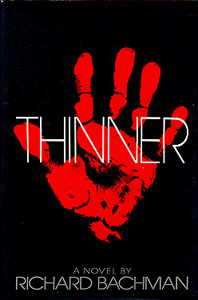
| Thinner |
|---|
|
|
Publication Information
|
Billy Halleck is a man used to affluence. He is overweight, and carries his heft like a status symbol. His doctor warns him he is edging into "Heart Attack Country," but his doctor also snorts cocaine in his office and offers some to Billy. Most of the characters in Thinner - Billy included - are portrayed as venal and shallow, and are consequently unable to grasp basic morality or form real relationships. The intrusion of the inexplicable into their world (in this case, Gypsies who come to town to perform for the rich) is also the intrusion of reality in their world. The Gypsies’ appearance in town forces Billy to confront the fact that there are people in the larger world who are not wealthy; this repulses him. At this early stage of the novel, Thinner seems opposed to the narrative intent of the earlier Bachman books; instead of a single man beleaguered by an oppressive society, Billy Halleck seems representative of that oppressive society. Here, knowledge of the basic structures of the initial four Bachman books provides excellent foreshadowing. As the novel progresses, we become increasingly aware of how tenuous Halleck’s grasp is on his comfortable life, and how quickly and completely he can become an outcast.
The thrust of the book hinges on a single moment: Billy’s wife Heidi surprises him with a hand-job while he’s driving. While Billy is distracted, he inadvertently hits an old Gypsy woman, killing her. Billy is able to use his connections - a judge, a lawyer, and a police officer - to avoid any serious punishment. On the steps outside the courthouse, another Gypsy, a very old man with a rotting nose, brushes his finger across Billy's face, whispering thinner.
Stephen King’s ability to find horror in the mundane comes again to the fore. As King modernized the vampire tale with ’Salem’s Lot, here he brings the creaky horror tradition of the Gypsy curse up to date, exploiting the American obsession with effortless weight loss. Greed and laziness emerge as two of the novel’s major themes as Billy begins to shed pounds no matter how much he eats. At first his wife and those around him are thrilled. But when the weight loss continues too rapidly and too profoundly, Billy swiftly enters into the realm of the freak.
It is here that Thinner truly becomes a piece with the larger Richard Bachman milieu. While Billy’s situation is most similar to that of Barton Dawes in Roadwork - albeit with a supernatural overlay - the motif of a man blocked off from society runs through each of the Bachman novels (with the exception of The Regulators, which features a small community literally blocked off from society). The structure of the book, too, is in line with the previous Bachman novels: Billy’s weight loss (marked by many of the chapter titles in decreasing pounds) follows the classroom clock in Rage, the dying Walkers in The Long Walk, the dates inching toward eviction in Roadwork, and the countdown chapter headings in The Running Man. Though King decided, with Thinner, to hew closer to the genre and tone of the novels written under his own name, the basic tenets of Bachman’s fiction remain (as they would, largely, for The Regulators and Blaze).
Much of Thinner is about the nature of consequences. When bad things happen, who shoulders the blame? That there are vague answers works to Thinner’s strength. In much of King’s - and Bachman’s - early work, specific villains can be discerned. Greg Stillson of The Dead Zone, The Shop in Firestarter, the Games Administration in The Running Man, Morgan of Orris/Morgan Sloat in The Talisman, Christine herself. Randall Flagg was the embodiment of evil in both The Stand and The Eyes of the Dragon. Even when good men go bad or insane - such as Jack Torrance or Louis Creed - a specific evil influence is at hand, like The Overlook Hotel, or the Pet Sematary. Only with Cujo had King explored the notion of guilt spreading to nearly all the characters, yet the coincidental nature of the book made much of the weight of that guilt seem inconsequential. In Thinner, people are punished for bad decisions and corrupt personalities rather than by accident ... although it is interesting that in both Thinner and Cujo, a child dies as a consequence of their parents’ actions.
Thinner was the last book King published under the Bachman name before publicly admitting the pseudonym. As Bachman’s first hardcover publication, Thinner had sold moderately well for a relatively unknown writer. King had hopes that the next Bachman novel, Misery, would make him big without King’s interference. However, a bookstore clerk and writer named Steve Brown linked King’s and Bachman’s names through the Library of Congress, and contacted King about it. When the story broke, hardcover sales of Thinner rose exponentially and hit #1 on the New York Times Bestseller list. One of the reasons the Bachman pseudonym existed was because King’s publishers feared that he would glut the market with too many novels. As the soaring sales of Thinner proved, King could publish as often as he wanted, and his readers would buy.