| The Mist |
|---|
|
|
Publication Information
|
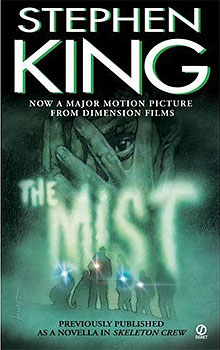
So what happens when a novella effectively becomes a novel? It's an interesting question. The Mist isn't as long as Carrie or The Girl Who Loved Tom Gordon, but it rivals The Colorado Kid for page count, and flat-out beats Blockade Billy. On the other hand, it is dwarfed by something like "The Langoliers," the lead-off story from Four Past Midnight. What makes a novel a novel? Is it page count? Is it the depth and complexity of the story? Is it the fact that a movie's coming out and the producers wanted a cheap way to market it in book form? I'm sure there are many factors.
What's intriguing is that The Mist actually works as its own novel, perhaps more easily now than at any other point in King's career. In 1980, when the novella was first published in the Dark Forces anthology, King was all about resolution. Books like The Dead Zone, Firestarter, and Cujo all had definite, concrete endings. Even the original publication of The Stand, which ends with the enigmatic, "I don't know," had had a satisfying climax and resolution (or two. Or three.) But The Mist? The Mist doesn't end.
It's interesting to contrast the legacy of The Mist and the reaction to King's more recent open-ended books. Where Lisey's Story and Dreamcatcher focused on motifs common in King's earliest work - psychic phenomena, children under threat from monsters - The Mist actually is an earlier work, anticipating (and now echoing) themes and narrative devices in King's more recent fiction. (This is reminiscent of Blaze, a "trunk" novel written concurrently with 'Salem's Lot yet published only recently, and sharing the same narrative structure as King's newest book, Lisey's Story.) While The Mist has long been a fan favorite, the reactions to books like From a Buick 8, The Colorado Kid, and Cell have been mixed, often angry, the main argument that King "didn't know how to end it, so he just stopped and left everyone hanging." There's a bit of disparity in that. Though King effectively concluded his exploration into open endings with Cell, this re-publication of The Mist (commercial concerns aside) seems an interesting coda.
How's the story? As scary as you remember, if not more. Reading it as a self-encompassing work like this forces the reader to pay attention to little details more - David Drayton's relationship with his son, for instance, and how he notices near the end that he's sleeping too much. It's a very human observation in a story that's very much about monsters. (The book's interest in Lovecraftian creatures and imagery again fits in with King's recent work, recalling the horrors of From a Buick 8, and a tertiary character in Cell - a woman screaming religious dogma in the streets, threatening Alice - brings to mind Mother Carmody.) David's determination to head home, no matter what the cost is understandable and palpably felt, yet he returns only to find out that the road is impassible. One of the few things keeping him going throughout the entire book is the hope that he might see his wife again. To have that hope yanked away by something as pragmatic as a tree in the road is indicative of The Mist's human perspective in the face of unreal horrors.
The book's narrative momentum leaves little room for complexity or depth, but those are not primary concerns in a work of this size and intent. Here we have a single situation and a few basic characters. The characters are allowed to grow and change, but only so much in the scant 240 pages allotted. What we have is a relentless, propulsive read with believable (if slightly superficial) characters doing the best that they can in an impossible situation. Interestingly, The Mist ends with the same word as ended "Rita Hayworth and Shawshank Redemption," something likely not overlooked when Frank Darabont chose to direct it. The Mist as its own book is a marketing gimmick, certainly, but its themes and structure place it convincingly in this stretch of King's long career, underscoring just how enduring a work it is.