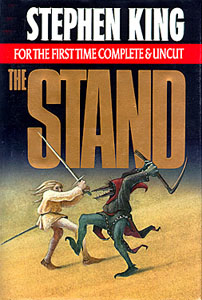
Limited Edition Information
| The Stand, Complete & Uncut |
|---|
|
|
Publication Information
Limited Edition Information
|
A Novel Critique
In 1978, Stephen King released The Stand, a mammoth epic that would go on to become his most popular novel. At the time, readers didn't know that King had been forced to excise nearly a third of the pages. King's publisher, Doubleday, was concerned that a book the size of The Stand's initial manuscript would be prohibitively costly. King, who was slowly gaining a foothold in the market but was by no means a sure thing yet, reluctantly agreed to make the edits himself.
The 1980s would prove to be King's most successful decade. Thirteen of his books went to #1. The revelation of his Richard Bachman pseudonym resulted in pandemonium for the original books, necessitating an omnibus release. Books he had initially released as limited-edition only - The Gunslinger, Cycle of the Werewolf, and The Eyes of the Dragon - were published in mass-market formats. Everything sold.
There was perhaps never a better time for King to revisit The Stand. King went over the original manuscript, reinstating the pages he felt were necessary to the book and updating the timeline to reflect more current events. This new version reflects King's original vision of an America decimated by a superflu, and the battle for the souls of the survivors. It debuted at number one, and remained on the bestseller charts for thirty-five weeks.
Epic in scope, The Stand cuts a swath through a decimated American landscape. In its initial pages, we are introduced to the superflu and the people first affected by it. This beginning section paints a picture of medical horror akin to something like Michael Crichton's The Andromeda Strain. We are witness to the easy, fluid way the virus - known as Captain Trips - spreads from person to person, and how quickly and effectively it kills. This first section frightens on a number of levels. The effects of the flu itself allow King to indulge in gross-out horror. Within the first ten pages:
Thick mucus had run from their noses and was now clotted there. Flies buzzed around them, lighting in the mucus, crawling in and out of their open mouths.
King does not shy away from these highly detailed descriptions, peppering this part of the book with them just enough so that the reader has a full grasp on the horror of what is happening. King had used biological horror to similar effect in the early short story "Gray Matter," and would return to the topic later in books like The Tommyknockers and The Dark Half, and to lesser effect in the scatological Dreamcatcher.
Beyond the visceral horrors, King sews the seeds of distrust of government, a thread running through some of his most powerful books, including The Dead Zone, Firestarter, and Hearts in Atlantis. As the novel widens its focus beyond individual deaths and those that perpetrated them, readers are forced to accept the greater terror: that America has been decimated, and 99.4% of the population is now dead. In Danse Macabre, King divides the horror genre into three basic categories - terror, horror, and revulsion, stating, "I recognize terror as the finest emotion and so I will try to terrorize the reader. But if I find that I cannot terrify, I will try to horrify, and if I find that I cannot horrify, I'll go for the gross-out. I'm not proud." In this first segment of The Stand, King manages to weave all three levels in and out of one another with such skill that readers don't notice the distinctions.
In this first section, readers are also introduced to the principal characters. It is here that the expansion of The Stand is most important. The Trashcan Man, little more than a puzzling cipher in the earlier edition of the novel, gets some much-needed character work. During his trip through the desert to find Randall Flagg, Trash meets a dangerous psychopath named The Kid, who emotionally and sexually abuses him during their strange time together. The Kid is a representation/culmination of the never-ending cycle of abuse and torture at the hands of others; Flagg represents inclusion, camaraderie. Trash's terror of and subsequent escape from The Kid works well to flesh out this relatively weak character, and to strengthen the resolve of his mantra, My life for you.
Some of King's female characters are similarly fleshed out. One of the cut scenes - a confrontation between Frannie Goldsmith and her mother regarding her unexpected pregnancy - underscores the character's decision to have her baby against monstrous adversity. In the prior edition, Frannie is a bit flat as a character, serving little purpose but as the catalyst for three other male characters - Stu Redman as her common-law husband, Harold Lauder as her obsessed would-be paramour, and the child himself. As Trashcan Man's devotion to Flagg makes more sense in this unexpurgated edition, so too does Frannie's devotion to her child. Now, she truly comes into her own, doing well to refute the notion that King can't write female characters older than ten and younger than eighty.
On a related note, Mother Abigail herself gets even more background and history. The ironic thing is, by giving Abigail Freemantle more to be proud of, her worry of committing the sin of pride, along with her subsequent journey, seems much more justified.
It is Mother Abigail's presence - and that of Randall Flagg, an enigmatic demon who looks like a man - that shifts the book away from clearly-defined horror into something broader. The characters dream of these figures, representing good and evil, and are compelled to travel to find them. Though the dreams are psychic in nature and Flagg is a supernatural creature, King addresses them as realistically as possible; as such, the intrusion of magic and esper abilities seems a natural outgrowth from the stark realism of the plague and the horrific events surrounding it. Mother Abigail's people gather in Boulder, Colorado and attempt to restart a rudimentary government, ratifying the Constitution and the Bill of Rights. Flagg's people, based in Las Vegas, are ruled by fear ... but also surface competency. The lights are on and the water is running, offering the illusion of normalcy, despite the fact that people are crucified publicly for criminal behavior. It is one of King's early and enduring comments on society, underscored most cynically in Thinner: that Americans are willing to endure (and ignore) crimes against their fellow man in exchange for creature comforts.
From the biological horrors of the book's first third to the Tolkienian quest of the second, the final section of The Stand sets the stage for a confrontation between the forces of good and evil. Given the nature and length of the novel, however, we don't see the participants as symbols. Characters on both sides are flawed human beings, and while the events take on the scale and scope of an epic battle, King never loses sight of the fact that there are people involved, and that by the end of the novel, we are fully invested in their outcomes. King would revisit this motif again and again in his fiction, especially in It (there are four distinct "battle" scenes that bond the Losers Club closer together), The Talisman, and Needful Things.
One minor issue that bears discussing: the book's take on romantic relationships. Some of the wording - "she's Larry's woman" and the like - seem out of place in this edition. Though the novel doesn't read as sexist - despite the term "Mother" Abigail and the fact that the pregnant Frannie Goldsmith is the novel's emotional center - some of the language seems outdated. One wonders if this is an outgrowth of who the characters are, if this is a reaction to the actual situation in the book (if the world were decimated and retreated to a more primitive society, wouldn't it stand that the more advanced cultural mores would retreat as well?), or whether this is simply a holdover from the earlier edition. It doesn't detract from the enjoyment of the book, but it is certainly something to ponder.
The story itself is richer, yet - oddly - seemingly more concise. It covers thousands of more words and hundreds more pages, but it still seems less sprawling than the original work. Part of the reason seems to be that every scene seems necessary, vital. It's not as if the characters behaved erratically in the first edition, but here the motivations are clearer, more relevant. Every scene works as a part of a much larger puzzle, each forwarding the characters or the story along in some important way. In comparison, the '78 version seems choppy, interrupting narrative flow and causing sections to drag. The pace and momentum of this version seems stronger, more propulsive. As with some of King's more immersive novels, words seem almost superfluous; you are not reading the book so much as living it, entirely inhabiting the world of King's post-apocalyptic America.
While some may have balked at King tinkering with it, this 1990 expansion seems not only necessary but organic to King's career. While the 1978 version anticipated his later epics, the unexpurgated Stand seems to actually follow his efforts in the 1980s - It, The Talisman, The Drawing of the Three, even The Eyes of the Dragon - as an obvious, ambitious next step. The advent of AIDS in the 1980s serves to make this edition of The Stand even more relevant and horrifying, the concept of a decimating plague no longer as far-fetched as it might have seemed in the late 1970s.
The success of the 1990 release of The Stand leads readers to wonder if King will eventually modify some of his other works. He has already re-edited and slightly expanded The Gunslinger to bring it more in line with the subsequent books in the series, and a re-release of 'Salem's Lot included some previously-excised material (though, unlike these other works, this material was not incorporated into the existing text). The original prologue and epilogue to The Shining were removed prior to publication; might those eventually see inclusion? What of books King has acknowledged later could have used more work, such as The Tommyknockers or Rose Madder?
While this is all speculation, it bears questioning. Though the 1978 edition of The Stand was one of his readers' favorite books, this new version only improved upon it. The result of King's re-examination of The Stand is a fully-realized, definitive version of one of King's best and most important novels to date.