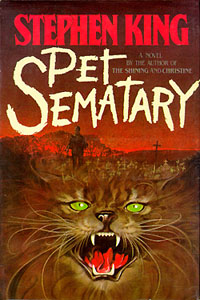
| Pet Sematary |
|---|
|
|
Publication Information
|
Pet Sematary is a novel whose foundations are built on dread. Even in the opening scenes - when we first meet the Creed family and begin to know their rhythms and personalities - a duo of portentous incidents threatens as the Creeds arrive at their new home in Ludlow, Maine. Ellie, Rachel and Louis Creed's daughter, falls painfully from a tree swing. Gage, their son, is stung by a bee, unnervingly recalling the resurrected wasps that attacked Danny Torrence in The Shining. In the first few pages, Louis, a doctor with a new job as a medic at the University of Maine, is already considering escape. His thoughts of ditching his life and dashing down to Disney World with his son are idle, but already prefigure later, much grimmer decisions.
Jud Crandall, the Creed's elderly next-door neighbor who becomes a surrogate father for Louis, introduces the family to the Pet Sematary, which lies behind the Creed home. It is a place local children have kept up as a way to bury and honor their beloved pets. The misspelling on the sign is the work of children, as well, and its very childishness takes on sinister weight as the novel marches onward, the novel's title hanging over the book like a blade.
The theme of death and its consequences suffuse the novel, threading through the narrative even in its more buoyant moments. Rachel Creed's death phobia comes to light early and often; her disfigured sister Zelda had died when Rachel had been eight and left alone with her, sending Rachel spiraling into a nervous breakdown. On the first day of Louis's new job, a badly mangled jogger named Victor Pascow dies in Louis's infirmary, using his last breath to issue a cryptic warning about the Pet Sematary. His daughter Ellie's crying fit over the possible death of her cat, Winston Churchill (called Church; the religious undertones of the cat's name and the family's surname are unavoidable) foretells the cat's actual death. And Jud Crandall, under the auspices of doing something to ease grief, offers to take Louis to the cemetery beyond the Pet Sematary, and bring Church back to life.
The novel, which blossoms open deliberately - but never slowly - now takes on a more urgent pace. Church comes back, but he comes back wrong. Louis, who spends much of the novel clinging to a rationality that serves him poorly, tries to make himself believe that the cat had only been stunned. Crandall, who has lived by the Pet Sematary and the grounds beyond his whole life, attempts the same sort of rationality when he introduces the place - the burying grounds of the Micmac Indians, who fled when "the ground went sour" - to Louis. One of the book's more subtle themes is that of fathers concealing selfish motives and convincing themselves they are doing the best for their children. That the burial ground's power extends to influence events beyond itself is a possibility largely ignored ... until, of course, it is too late.
In the book's only purely optimistic sequence, Louis is alone with Gage, flying a kite. It's a simple scene, brimming with possibility. Upon a re-read of the novel, it is a sequence terribly hard to read. Gage Creed's death at the opening of the second part of Pet Sematary is handled indirectly (as is the later scene in Misery involving the removal of Paul Sheldon's thumb), but the implications of it are brutal. Only slowly do we come to understand how Gage came to be run over in the road, just as Church had been previously. That Louis intends to disinter his son and bury him at the Micmac Burying Ground - despite warnings from Pascow, Crandall, and his own better intentions - is presented as an implacable end. At this point, the novel's urgency takes on a fevered pitch that simply doesn't quit.
Yet still, that early deliberateness is at work. Though it might have been easier for King to gloss over Gage's disinterment, King delves into the details of Louis's "mad work." During this entire sequence, King gives Louis plenty of outs, plenty of last chances to turn his back on what he intends to do. Louis ignores all of them, sometimes willfully. Even the vagueness about what might come after Gage's return doesn't dissuade him; his dream of becoming a medic at Disney World has returned with an awesome, beguiling clarity. The further Louis sinks into his delusions, the more we become aware that his actions are driving him insane. Louis himself may understand this; if so, he ignores that, too.
One of the more persistent motifs of Pet Sematary is the recurring image of a spiral - the pattern on which the graves at both the Pet Sematary and the burial ground beyond are set. As the book races toward its devastating finish, Louis Creed draws a spiral in the dirt atop his son's grave - an admission that despite his mind's increasingly weak protests, he really has no choice. The strength of Pet Sematary's narrative comes chiefly from that concept, the idea that once things reach a certain point, free will no longer matters. It is impossible to deviate from the set path. The book's chilling final sentence - "'Darling,' it said." - and its implications indicate that we have reached the center of the spiral, from which no light or hope can escape.