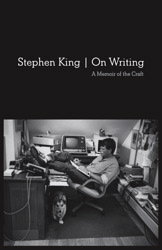
| On Writing |
|---|
|
|
Publication Information
|
On Writing, however, is arguably a more central work to King's canon - perhaps the most important book he has ever written. Where the Dark Tower books connect King's fictional worlds, On Writing serves as a thematic summation of King's career. This slim volume tackles concerns King has been thinking about and writing about his entire career: why people write, why writing is important, how writing happens, why writing happens, what writing is. While Carrie touched only lightly on writers (with its epistolary interruptions, some of which are purported excerpts from Sue Snell's autobiography), both 'Salem's Lot and The Shining have writers at the centers of their stories, the act of writing a method of simultaneously coping with and clarifying horrors. In the foreword to Night Shift, King explains why he writes short stories (a sequel of sorts to this short essay appeared decades later in Everything's Eventual, in which King explains why he still writes short stories). Even in this nascent stage of King's career, he is fascinated by what he does, and why he does it.
Later fiction - especially a sequence of novels and stories beginning with Misery and including The Dark Half, "Secret Window, Secret Garden," Bag of Bones, "Umney's Last Case," among others - centered on novelists attempting to define what their work means, both to their readers and themselves. More, King began exploring how creativity impacts real life, and how life and fiction inform one another. Even the Dark Tower books eventually coalesced around the theme of fiction's powerful hold on reality, finally focusing on King himself as a character. Concurrently, the real Stephen King addressed writing more directly, in various forewords, afterwords, and essays: his take on being labeled a horror writer (Different Seasons), why he developed and continues to use a pseudonym (The Bachman Books), how the process of editing affects his work (The Stand: Complete and Uncut), among many others. It has long seemed as if King is not content that readers simply enjoy his finished work; he wants them in on the entire process.
The long first section of On Writing, "C.V.," allows us to witness the beginnings of Stephen King, the storyteller. In rough chronology, King shows us his young self, from his first games of pretend up through the sale of the paperback rights for Carrie: in short, his journey to becoming a successful novelist. This section directly connects On Writing with King's earlier nonfiction book, Danse Macabre, especially the chapter, "An Annoying Autobiographical Pause." The earlier work concerned itself mostly with young King's fixation on horror and the fantastic, including fascinating background on the places and people in his young life that led him to it. Here, he expands on those threads, talking more about his early development as both a person and a writer. His mother's (and later, his wife Tabitha's) constant support of him as a writer is especially heartening, providing a stable basis against overwhelming discouragement. One of On Writing's most important sections discusses a teacher's disapproval of King's chosen subject matter.
"I was ashamed. I have spent a good many years since - too many, I think - being ashamed about what I write."
This incident would later color King's massive It, particularly a scene in which Bill Denbrough argues with a teacher about the merits of impenetrable "literature" versus commercial storytelling. It also goes a long way toward explaining King's often self-deprecating attitude toward his own work during his early and mid-career. In a famous quote from King's Time magazine cover story, King described his writing as "the literary equivalent of a Big Mac and fries." Only in 1998, when King switched publishers and actively sought a more diverse audience, did he seem to regard his career and the work he did as having literary merit.
King also confronts the addictions that later threatened his life and his marriage. With unusual candor, King discusses his growing alcoholism. As a storyteller, King peppers this progression with foreshadowing and occasional dark wit. One drink steadily becomes a case of beer a night, and he admits to being drunk at his mother's funeral. Perhaps most fascinating for readers are the ways these addictions impacted his career, especially how he wrote sections of The Tommyknockers with cotton balls in his nose to staunch cocaine-induced nosebleeds, or how he cannot remember writing Cujo, having been drunk during it.
King concludes this first section by summing up concepts he has put forth in so many of his novels and stories about writing (and later, in Duma Key, about art in general) with two sentences: "Life isn't a support system for art. It's the other way around."
In small chapters titled "What Writing Is" and "Toolbox," King attempts to define how writers communicate with readers ("telepathy, of course," but he's not being glib), and the basics of what potential writers need. He covers grammar, vocabulary, dialogue, and parts of speech, managing to be serious and funny at once ("plums deify" is one of On Writing's best little jokes). He champions Strunk and White's Elements of Style whenever possible and lambasts adverbs with an obsessive fury (he isn't much a fan of pronouns, either). Most interesting is that while King stresses the importance of these nuts and bolts of writing - the construction of sentences and paragraphs that make sense - he also stresses that writing is magic, that these basics can be uses to create things far greater than the sum of their parts.
King examines the major facets of his craft in the large eponymous section. In "On Writing," he presents everything he knows about writing well - the magic as well as the mechanics. Reading, he stresses, is nearly as important as writing on a schedule, and with a challenging but achievable word count per day. Word count is one of the somewhat controversial concepts King puts forth, believing that 2,000 words a day is in everyone's grasp. If it seems an excessive amount for busy people who cannot yet support themselves as writers, King has provided his own hectic background as evidence that it's possible for those who are driven. Another controversy is his dismissal of plot, believing it hinders storytelling (in an interesting aside, King states he believes that two of his plotted books, Rose Madder and Insomnia, seem to be trying too hard).
Additionally, King approaches the big questions for writers, like the proper way to edit, submit, and find an agent. He also suggests that writing itself happen in quiet places: a home office or back bedroom with a door the writer can close. While this seems to contradict the writing ethos of someone like J.K. Rowling, who wrote Harry Potter and the Philosopher's Stone in London cafes, King explains his reasoning clearly and convincingly. Indeed, all the advice he puts forth in the "On Writing" section seem reasonable, due to King's assured tone. He believes, so the reader believes.
The final major section, "On Living: A Postscript," concerns the accident that nearly killed King in the summer of 1999. Parts of this section are difficult to read; King's familiarity with the language and tenor of horror fiction has uniquely prepared him to discuss the details of his accident and the resulting injuries. (This accident would reverberate throughout King's later fiction, especially in Dreamcatcher and From a Buick 8 - even though this latter book had been in large part written before the accident - and the recovery process would find its way into Duma Key.) However, King's slow recovery is inspiring to watch, and King does not downplay the role writing played in it.
"There was no miraculous breakthrough that afternoon, unless it was the ordinary miracle that comes with any attempt to create something … There was no sense of exhilaration, no buzz - not that day - but there was a sense of accomplishment that was almost as good."
In a series of postscripts, King provides a before and after editing session with a portion of his short story "1408" (which would later appear in Everything's Eventual), and a list of books he had read and enjoyed recently. The tenth anniversary edition of On Writing includes a new list of books, covering the decade since the book's original publication.
Serving as a summation of all of King's thoughts about writing up to that point (effectively linking much of his fiction and nonfiction together into a cohesive whole), On Writing also serves as a springboard for his later work. The remaining Dark Tower novels fictionalize King, interpreting his writing as the nexus of Roland's vast worlds. Song of Susannah also gives us an interesting - if fictionalized - view of King's writing and publishing process regarding the Dark Tower novels, and also imagines a universe in which King did not survive his car accident. The final three Dark Tower books, among other things, serve as fictionalized sequels to On Writing. Additionally, King's later work in Dreamcatcher, Lisey's Story, Duma Key, and some of the stories in Just After Sunset are outgrowths of the concepts King puts forth in On Writing.
More than any other book in his canon (with the possible exception of It), On Writing symbolizes who Stephen King is as a writer. Concise, accessible, revealing, and useful, it is impossible to overstate the importance of On Writing.
2000 Review
When I was in eighth grade, American History was one of my favorite subjects. It wasn’t because I was particularly fond of history, but more because my teacher – Mr. Boreri – approached his classes in a unique way. Most of the time, our course of learning would go on as normal: lectures, book reading, notes, notes, notes. But once a class, he would break the monotony, telling us to put down our pencils: we were going to hear a story.
Mr. Boreri’s stories added depth to his subject, helped us put the nation’s sprawling history into some frame of context. In Stephen King’s book On Writing, he employs the same tactic. This slim book is offered up as sort of a continuation of Strunk and White’s The Elements of Style, a course on how to write, what to write, and the tools with which you need to do it. That’s the bones. The meat is in King’s personal reflection – how he came to be the writer he is, how he works, day by day, and what writing has come to mean to him. Stephen King is playing the role of the mentor, the teacher … but he’s not making you take the journey alone.
The first section of this book, “C.V.,” is probably the closest we’ll ever get to a straight autobiography of Stephen King. Beginning at King’s earliest memory (imagining he is the strong man at a Ringling Brothers circus) and continuing up through the paperback sale of Carrie, King’s first novel, this section details his daily struggles of a talented young writer who has yet to make the Big Time. King assumes you haven’t heard the legends: the story of King buying a hair dryer for his wife after hearing the staggering amount he would be paid for the paperback rights for Carrie is recounted in loving, first-person detail. Other aspects of his personal life, such as King’s addictions, and the story of his mother’s death, have been hinted at before. Here, King is honest and open, divulging far more about his private life than one would have guessed. But fair warning: this is not a tell-all confessional-type book. Everything King shares holds a purpose, every anecdote a connective strand to other parts of King’s rich life story. And almost everything has to do with writing.
“Toolbox,” the second section, and “On Writing,” the third section, get down to the business at hand: how King writes (and reads), and how he assumes it will work for you. Even those who have no interest in writing themselves may find the way King goes about it intriguing. He’s death on adverbs, writing workshops, and, oddly, plot – seemingly strange for someone who has built his life on stories, but his explanations are fascinating. As if a teacher for a half-semester Accelerated Writing class, he assumes you know the basics and speeds you through the course. Each sub-section builds on the last: after you work out your writing environment, you can attempt description; after that, dialogue, and so on until King brings you to the subject of agents and cover letters. Peppered throughout this lecture are quite a few stories, relating incidences from his own life in the book trade. He’s surprisingly frank about what he thinks works in his novels and what doesn’t (at one point, he divulges that he things merely having a plot hurt both Insomnia and Rose Madder.) By the end of the “On Writing” section, King’s lesson is complete, but he has one last story to recount.
In “On Living: A Postscript,” King talks about the accident that nearly killed him in the summer of 1999. He doesn’t spare any of the details: remember, this is a man who has made a living at least partially on fictional blood and guts. But here, we know, the tale King is telling is not a fiction, and his long, painful recovery is not a vicarious thrill. King’s wife, Tabitha, who helped change their lives over two decades before by fishing the discarded first pages of Carrie out of the trash, was instrumental in getting King back on track this time, too. When he suggested he might be ready to start writing again, she didn’t hesitate, building him a miniature writing studio at the end of a hall in their home.
King doesn’t see his first, fitful attempt at writing after the accident miraculous, but on this point, I disagree. Beyond a mere manual of writing technique, On Writing is a testament to the power of the written word. Sentences, paragraphs, books: all imbued with the force to change lives and shape lives. As King demonstrates more than once in this little volume, writing may actually have the power to save lives, as well.