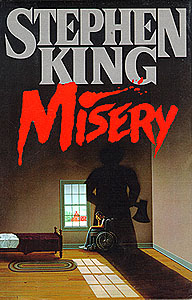
| Misery |
|---|
|
|
Publication Information
|
Paul Sheldon is the author of a popular series of romance novels starring his heroine, Misery Chastain. Growing restless to break out of the genre (and to stop writing Misery, who he has grown to resent), Paul has written a new novel, something "serious" called Fast Cars. After finishing this manuscript, Paul is caught in a snowstorm and crashes his car. He is saved, barely, by a nurse named Annie Wilkes, who informs him, even in his convalescence, that she is his "Number One Fan."
The situation intensifies as Paul realizes he hasn't been rescued so much as captured. During an early scene Annie, wrapped up in a story she's telling, ignores Paul's requests for pain medication until he is reduced to begging; it is here Paul begins to sense he is in trouble. Soon, the truth of Annie Wilkes begins to assert itself: she has a child's view of right and wrong, good and bad. The world is divided into Do-Bees and Don't-Bes, and the qualifications for each are as mutable as the changes in Annie's mood. Her cheerful, silly vocabulary - words and phrases like "oogy," "dirty bird" and "cockadoodie" come early and often - is undercut by her demands, and the punishment she doles out when her demands are not met.
When Annie discovers that Paul has killed off Misery Chastain in his last book, she forces him to burn his manuscript for Fast Cars and begin work on a new Misery novel that brings her back to life. Here, the book's true intent begins to emerge. Initially beginning Misery's Return (a chillingly apt title) as he had written his more recent Misery novels - that is, without real involvement in the characters or story, writing only to fulfill the requirements - Annie chastises him for not playing fair. Annie's demand that the story be honest forces Paul to invest himself more fully in his writing than he had in the past.
It also forces him to try to understand why he writes, and to what end. At the outset, he writes Misery's Return simply to please Annie, and to avoid her wrath. As the story grows, he comes to rely on it as an escape from his situation Ö and then to depend on it in other, more vital ways. His output improves, and he finds he is writing more a day than he ever thought possible, at one point attempting to on while exhausted and in extreme pain. King's characters have often been self-aware enough to know when they are wading into metaphorical waters, as had Jack Torrance when he plunges his hand into "The Great Wasps' Nest of Life." In addition to understanding the irony of the word "misery" - another of King's fantastic double-meaning titles - Paul makes an offhand reference to John Fowles's The Collector (whose plot mirrors that of Misery), and further recognizes that he is trapped inside the Scheherazade tale, telling Annie his story to stay alive. Late in the book, he comes to realize that he has also become Scheherazade to himself; that is, he continues to struggle for survival so he can see how Misery's Return comes out. The fact that he keeps the manuscript at the end instead of burning it is a testament to his dependence on the book.
At once Paul's captor and his muse, Annie becomes a metaphor for the creative process. Her insistence that he write fairly and consistently forces him to dispense with shortcuts and prevarications. She gives him faulty tools - a typewriter that throws keys and, initially, paper that smudges - and he finds himself able, and at turns eager, to write (even though, in his pre-Annie life, any minor distractions would render him unable to write much at all). When he implicitly threatens to stop writing - by means of escape - she "hobbles" him, cutting off one of his feet (one wonders if the fact that the typewriter's first missing key, the absent N that cuts off the end of Paul Sheldon's name, is a subtle foreshadowing to Annie cutting off the end of his leg). When Annie goes against her own best interests and begs Paul to tell her the rest of what happens, he refuses. She punishes him for this, too, cutting off his thumb. That he suffers his first real writer's block as a result makes sense on two levels: symbolically, the fact that his muse wanted him to "cheat" his way to the ending is contradictory to his creative drive. More literally, while a writer can function without his foot, he is actually hobbled more when his instruments - his hands - are threatened.
Still, though Annie coerces and occasionally threatens Paul to write, the very act of writing leaves her in awe. When Paul writes his first "fair" version of Misery's Return, she can sense the power of his words and the creative force. Midway through the book, when Paul has a breakthrough about his novel's plot, he demands Annie bring him a notepad and pens so he can get his ideas out - going so far as to tell Annie to be quiet - without thought as to the repercussions. Far from being angered, Annie's reaction is humbled and slightly fearful, struck almost penitent in the presence of pure creativity. Conversely, tools such as Webster pots and a writer's concordance - names, places, and other information authors sometimes as a guide - don't interest her at all. In a symbolic sense, King is stating that the ephemera of writing matters very little when compared with the process and the story itself; even a typewriter that throws keys is no obstacle to a story that demands to be written.
In addition to defining writing (and, by extension, the act of creativity) as a positive force, King is quick to explore its drawbacks. Drawing a convincing parallel between Paul's addiction to Annie's Novril-brand painkillers and his newfound addiction to writing, King suggests that all forms of dependence come with a cost. King would tackle this darker aspect of creativity in the later works The Dark Half, "Secret Window, Secret Garden," The Dark Tower, and Duma Key. In his nonfiction study, On Writing, King sums up: "Life isn't a support-system for art. It's the other way around."
Much of Misery asks - and attempts to answer - questions about the delicate balance of power between authors and the things they create. Far from being a dull rumination on art and its consequences, though, King has woven these elements into the fabric of a taut psychological thriller. His characters are fascinating; while Annie Wilkes may work on symbolic and allegorical levels, King never forgets that she is human Ö albeit with an outsize personality and a chilling backstory. Paul Sheldon's journey of self-discovery is similarly rounded out by precise character touches, at one point wishing simply to hear some rock and roll. We feel Paul's disconnect from the larger world, and it is among the book's more subtle sorrowful moments. In later portions of the book, Paul and Annie actually attain a level of mutual respect, even companionship. As always, it is in these quieter moments that King makes his people seem real.
However, King does not shy away from scenes of visceral horror. Despite the lack of any supernatural intrusion, Misery might be Stephen King's goriest novel. The hobbling scene is one of King's most disturbing, rivaled only by a sequence involving a riding lawnmower and an unfortunate police officer. Here, King is proving the point that Paul Sheldon makes with Misery's Return: no matter the genre or the popularity of their authors, books are as important as the author's intent. Books that entertain can also be serious and have something to say, so long as the story is told well, and honestly.