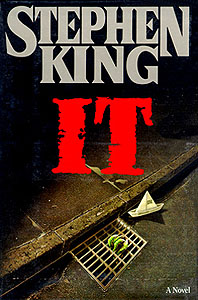
| It |
|---|
|
| Publication Information
|
It marks a deliberate shift in Stephen King's career, a stated conscious decision to sum up everything he had to say about children and monsters. It also functions as a statement of intent as to what he hopes to accomplish with his later novels: explorations of adults and the dual natures of creativity and creation. One of King's most important books, It is a massive undertaking, not only addressing and expanding upon the themes in his earlier fiction, but also transcending those themes, uncovering and creating something new.
A novel as long and complex at It defies simple summary; as with most of King's novels, the real story lies in the characters rather than the plot or situation. One of King's most clever devices is his technique of developing his main characters through the observances of lesser characters. Used to great effect in The Dead Zone (in which we come to know Johnny Smith through the impressions and reactions of Sarah Bracknell), in It, King approaches his characters even more cautiously, discovering each of his seven primary characters through the eyes of secondary - and even tertiary - characters. He is fascinated by these people, and develops them slowly and richly enough to allow readers to become fascinated by them, as well. Advancing this technique further, King introduces these people as adults, in a series of short vignettes that eventually give way to their lives as children. Even at this early stage in the novel, we begin to sense how profoundly the events of 1958 have shaped the adults of 1985.
King's seven characters - eventually known collectively as The Losers Club - begin the summer of 1958 in Derry, Maine as loners, each an outcast "type": Ben Hanscom is fat, Beverly Marsh is poor, Eddie Kaspbrack is asthmatic, Mike Hanlon is black, Stan Uris is Jewish, Richie Tozier wears thick, "Coke-bottle" glasses, and Bill Denbrough stutters. At twelve, these characters are classified and limited by these traits, but as with most child characters in King's fiction, it is not who they are but what they do that truly defines them. Only by coming together and sharing their talents with one another do they truly blossom, cementing their later roles as adults.
Structurally, It is King's most ambitious work, tackling dual time frames that parallel each other and eventually merge. Most of the adults in It have lost the memories of their childhoods completely, and only over the course of the novel do they regain them. What results is a split narrative of discovery and action that works on literal, symbolic, and allegorical levels. King's clever reversal of the two years - '58 and '85 - recalls George Orwell's 1984, published in 1948; King himself had used a similar reversal with The Shining's "redrum." The 1958 segments function largely as coming-of-age story, as children learn how to be adults (culminating in a frank sexual sequence that is at once shocking and moving); as the adult Losers begin regaining their memory, they are learning how to be children. The notion of forgetting the past is a central conceit in It, as the citizens of Derry have learned to ignore the cycle of violence and death that has defined the town since its inception.
"Can an entire city be haunted?" This question, posited by Mike Hanlon in the first of his five "Interlude" segments, introduces the primary conflict of It early on. In these segments, interpolated throughout the text, Mike sketches the brutal history of Derry, Maine. Part of the reason It functions so well is the effectiveness of these segments, which not only form a backbone to this sprawling book, but also prove the nature of It's influence on the town. Mike's history of Derry is also a history of It, monster and town feeding off one another in the same mutual parasitism King had explored between Todd and Dussander in "Apt Pupil," and later between Paul Sheldon and Annie Wilkes in Misery. More than simply being It's minions, the Derry residents are more fundamentally of It, understanding and cooperating with It on basic, subconscious levels. That adults - and more specifically, parents - can't see the blood that burbles out of Beverly's bathroom drain is symbolic of their literal ignorance of Derry's astronomical murder rate, or, in several instances, the way they dismiss violence even when they do see it.
Indeed, It serves as a definitive statement on the cruel and absent parents populating King's early work. Beginning with Margaret White in Carrie through Roland's treatment of Thomas in The Eyes of the Dragon, much of King's early work is a study in the various ways parents can hurt their children. The Overlook exploits Jack Torrance's physically abusive relationship with Danny in The Shining, Rachel Creed's parents leave her with her dying and deformed sister in Pet Sematary, and Charlie Decker's father both psychologically and physically abuses him in Rage. Even "good" parents, through either their actions or behavior, destroy their children. Arnie Cunningham in Christine, Tad Trenton in Cujo, and Linda Halleck in Thinner die as a direct result of their parents' actions, whether their parents intended maliciousness or not.
In It, the Losers' parents damage their children in vital ways. Bill's parents, still distraught over his brother George's death, essentially ignore him. Ben's mother overfeeds him. Eddie's mother creates an atmosphere of codependency by convincing him that he is constantly sick. Beverly's father is physically and, perhaps, sexually abusive. We see Stan's parents only in vague sketches, but we learn that they are opposed to his marriage, thinking him too young; that his parents themselves married young is an early, subtle indication of grownups forgetting the impulses of "the kids." One of the more telling moments is a segment when Richie breaks his glasses and his mother won't listen to the truth of how it happened; though minor, this moment shows that even parents who are ostensibly kind and understanding cannot be trusted. (This motif extends beyond the Losers' Club; Henry Bowers' father systematically abuses him mentally, physically, and spiritually. His tenuous grasp on sanity is directly related to his father's own mental deterioration, allowing him to be more malleable to It's influence, and thus the Losers' most dangerous enemy.) Only Mike's parents - especially his father - seem truly understanding and sympathetic. Mike's father passes on a healthy interest in history (the only instance in which a parent's interest directly assists the Losers in their battle with It) and teaches him life lessons that instruct rather than damage. Mike's close bond with his father symbolizes his similar bond with Derry, which he claims at one point to love.
These segments are ostensibly Mike's journal entries, and peeking in at them serves to give the reader an even more intimate experience with this character and the town he remains fascinated by. In many important ways, It is a historical novel. King's study of Derry since its inception through its days as a small town and into its "present" state as a small city is a history of America - particularly New England - in microcosm. Late in the book, King even introduces pre-history into the narrative, as Richie and Mike (whose presence here as the resident Derry historian is important) witness It's arrival during the Smoke-Hole Ceremony. In a real-world context, It is now a historical artifact of the time it was published. King's two narrative streams - 1958 and 1985 - take place twenty-seven years apart; as of this writing, it has been nearly that long since the novel's publication date. King has returned to Derry a few times since It, most notably in Insomnia (in which Mike Hanlon appears) and Dreamcatcher, but neither has explored Derry's more recent history as deeply as It had done (though Dreamcatcher, with which it shares surface similarities, provides some details).
If It is, at least to some extent, a history of towns and people, it is also a history of monsters. It's nature is such that it takes the form of whatever It's victims are most afraid of. In children, these fears are made manifest as monsters. Drawing from literature, film, even television, King populates his novel with any number of horrifying creatures - Dracula, the mummy, Rodan, the Creature from the Black Lagoon, the Teenage Werewolf, the Crawling Eye, dead children come to life (in various forms; both Bill and Stan are visited by revenant boys), giants, the witch from "Hansel and Gretel," among others, are all forms It takes at various points. For Eddie Kaspbrak, It even becomes the personification of disease, a terror instilled in him by his mother - another oblique way in which parents are hazards to their children.
It magnifies the fears of adults as well, which cannot, in general, be solidified into a specific shape: King draws sketches of racism, poverty, spousal abuse, addiction, and mental instability as particularly troubling in Derry. A chillingly brutal homophobic murder at the start of the book actually kick-starts It's waking/feeding period in 1985, a ritual sacrifice portending further horrors in the same way as Ralphie Glick's murder had in 'Salem's Lot. Like Barlow, It seems to require a sacrifice at the beginning of its conscious periods, and additionally seems to require a large-scale act of violence before it returns to hibernation. In one of Mike's "Interlude" segments, he relates the story of the fire at the Black Spot, a black nightclub of sorts, whose burning signaled the end of It's activity in Mike's father's time.
Both racism and homophobia are trenchant themes in It. The mere suggestion of gay sex is enough to drive Henry Bowers closer to insanity, as, later, a similar suggestion leads to Adrian Mellon's murder. It is worth noting that when the Losers discuss homosexuality, it is always in terms of facts, rather than negative reactions (reminiscent of how Jack Sawyer in The Talisman would respond to male affections). A subtle but persistent thread running through King's work is that his "good guys," as well as his authorial voice, is for the most part neutral on the subject of homosexuality, with the exception of the bisexual hero Dayna Jurgins of The Stand. Only later would King begin to feature gay characters in more prominent, heroic roles in novels like Insomnia, Rose Madder, and Cell.
It may also serve as a response to criticisms of King's treatment of black people in his novels. Much of King's early career had utilized black characters in the stereotypical roles of either messiah or villain. Mother Abigail from The Stand is an almost literal interpretation of a messiah (as is the much later John Coffey in The Green Mile) and Dick Hallorann - who actually appears in the Black Spot sequence in It - fulfills that role to an extent, as well. On the other hand, Killian, the evil megalomaniac of The Running Man - already a book featuring an uncomfortable number of racial stereotypes and epithets - is black. With The Drawing of the Three, King first presented in Detta Walker a black caricature that other characters realize is a caricature; both her alternate personality, Odetta Holmes, and her merged personality, Susannah Dean, are non-stereotypical characters defined by characteristics other than race. Mike Hanlon's race is not mentioned once in the first half of It, perhaps as a way of stating that Mike's seemingly defining characteristic is not his most important or interesting trait ... a motif that carries through the rest of the Losers.
While Richie views his thick glasses as his reason for "Loser" status (which serves to solidify many of his impressions of It; the Crawling Eye the Losers confront in the sewers comes from Richie's fear, and even the giant Paul Bunyan statue that attacks Richie is a product of magnification), it is his often inappropriate humor that serves him well as an adult and makes him invaluable in the battle against It. Ben's weight is eclipsed by his love and innate sense of architecture, integral to the construction of both the dam in the Barrens and the Smoke-Hole. His role as a builder is important metaphorically, as well: it is through his presence that the Losers Club first coalesces. Eddie's asthma and other disabilities make him a victim of both other bullies and his overbearing mother, but it is his directional sense that saves the Losers in the sewers and translates into his adult career as a limousine driver. Stan's Jewishness doesn't come into account at all, though his fastidiousness works to the Losers' favor following the blood explosion in Beverly's bathroom, and also anticipates his method of suicide as an adult (as does his insistence on the blood oath at the end of the Losers' first battle with It in 1958). Stan's career as an accountant is very subtly suggested by the Laundromat scene, in which Stan is the only one with money. Beverly's nascent interest in sketching (taught to her by her father) expands into her design business as an adult, but it is her targeting sense that saves the Losers in their three major confrontations with It, and also saves her in her fight with her husband at the start of the book. Bill, who doesn't stutter when he writes, becomes a famous novelist; it is his abiding belief in make-believe (as well as his guilt and vengeance for his brother's murder at the hands of It) that truly defines him and makes him a leader.
Bill's role as a writer is tied inextricably into the basic framework of It. In an early autobiographical scene, Bill Denbrough rails against those who value fiction solely in terms of metaphor and allegory, ignoring seemingly important elements such as story itself. King would later extrapolate on these thoughts in depth Misery, The Dark Half, and Bag of Bones, and to some degree in The Tommyknockers and the latter books in the Dark Tower series. In these later works, King examines the darker and more negative aspects of creation directly; here, King explores these thoughts through the shapeshifting nature of It. Bringing fiction into the real world can literally kill you. King also asserts the inverse, however: belief in monsters begets belief in ways to kill them. Through his writing, Bill retains a closer connection to monsters, magic, and childhood; it is perhaps only through his faith in these things that he is able to rescue his wife at the end of the book.
It is one of King's most successful novels, impressive on multiple levels. King's ability to balance a split narrative coherently, while also introducing further historical anecdotes, seems effortless. Juggling multiple points of view - including the technique of shifting point of view several times in the same paragraph - is risky, but here it reads easily, seeming to grow naturally out of the characters' close bond. By grounding the book in character, King is able to juggle genres without disrupting the flow of the book, from supernatural horror to historical novel to coming of age story, and finally to cosmic horror approaching science fiction. Special attention must be paid to the pace of the book, which for a very long novel is terrifically fast, attaining a cinematic feel in which words themselves seem almost unnecessary. While the destruction of Derry at the book's climax is a bit similar to the wreckage in King's fictional towns - a sequence King first used in Carrie and would continue through The Tommyknockers, Needful Things, Bag of Bones, and beyond - that narrative pace carries the readers through so quickly that one doesn't get bogged down.
Perhaps the most important turning point in King's career, It stands as both a summation of his past work and a statement of purpose about his future. Beyond that, though, It is a remarkably well-written and well-constructed novel, accessible, enjoyable, and emotionally rich. The last elegiac paragraphs remain some of King's most resonant, echoing in readers' memories long after the book is closed.
2007 Review
At this point, it would be impossible for me to view Stephen King’s It with any sort of objectivity. I’m not sure I’d even want to, if I could. Between the ages of thirteen and thirty-two, I’ve read It twelve times – that works out to a little over 13,000 pages, all told, spent with just one book alone. That’s not counting the snippets, either. Whenever I fly anywhere, I bundle along It, my travel-time talisman. During takeoff, I pull the novel out and open to a random page, letting myself get lost in the words. Takeoffs terrify me, but It makes things seem all right.
Which is odd to say, I suppose, when discussing a book that can quite rightly be called King’s horror magnum opus. It’s a monster book, at least on the surface, calling up old terrors like Dracula, the werewolf, the mummy, zombies, even giants and witches. Dig just a little bit deeper and there are the other, more mundane (but maybe even scarier) horrors: disease, child abuse, spousal abuse, racism, homophobia, loneliness, childhood bullies, insanity, and the sudden, shocking death of a loved one. These two realms of fear – the real and the purportedly imaginary – coexist easily in It, each feeding off one another in a sort of supreme act of mutual parasitism. It should, by all rights, be terrifying. Maybe it was, once, for me. But now, every time I pick up It, I feel a comforting sense of coming home.
There’s a new MasterCard ad on the trains around Boston now, featuring two different placards. One says, “The day you became a Red Sox fan: birth.” And it shows a nice new Red Sox cap. The other says: “The day you became more than a fan: priceless.” And now the hat’s all beaten up and tattered and falling apart. It looks, to my mind, a lot like my original hardcover of It, handed down from my Uncle Doug when he went off to college and left me all his old stuff. See, It isn’t where I started the Stephen King thing. That started back when I was nine, reading my friend Christian’s copy of Cycle of the Werewolf at sleepover camp, and, later, his Creepshow when he stayed over my Grandparents’ house for the night. After I got Doug’s books when I was twelve, first I read some stories in Night Shift. Then I read Rage. Only then did I heft this gargantuan book off my shelf and, with a nervous sigh, flip the cover open and start reading. That’s the day I became more than a fan. Priceless.
See, I came for the monsters advertised on the flap. That’s why, I think, most people come to King. What I didn’t expect, and what none of the previous Stephen King books I’d read had prepared me for, was that the book wasn’t about monsters. Beyond anything, It is a book about friendship, and the bonds between people who love each other. When I was twelve, that concept fired my imagination more than anything else I’d ever read. Young me, bookish and strange, didn’t really have much in the way of friends myself. My buddies were books, and mostly that suited me all right. But inside this book, there were seven people, roughly my age who were a lot like me: kids who were picked on, punched on, outcast, Losers. Kids I could identify with. And it all starts (maybe, just maybe, in more ways than one), with a scared fat kid running from some bullies, and literally falling into some friends along the way.
It takes time to build an indelible bond between seven well-drawn, believable characters, time and pages. It’s that bond that makes up the core of the book: it’s that bond that brings them together to try to kill It for the first time, and it’s that bond that brings them back nearly thirty years later, to finish what they started. That’s King’s main thrust: getting you to fall in love with these people, both in the past and in the present, and understand their ties to each other so deeply that you feel a part of them yourself. But King has another agenda, as well: while building history between the members of the Losers’ Club, he’s also building the history of a town. As Mike Hanlon – the only member of the Losers to have stayed and grown up in Derry, Maine – asks, “Can a whole town be haunted?” Throughout a series of five “Interlude” segments, Hanlon – in the first person – sketches for us a brutal history of Derry. The cycle – a period of intense violence for Derry, coinciding with It’s waking (and feeding) periods, occurring roughly once every twenty-seven years – stretches back through Derry’s long and tortured past. How far back is a revelation in the book I wouldn’t dream of spoiling for the uninitiated; suffice it to say that Mike is there to find that out, too.
I’ve gone into such detail about the Interlude segments – which are really somewhat minor sketches on the edgings of the giant canvas of It – to reveal something about myself. The first two times reading It, I skipped the Interludes almost entirely. They just didn’t seem important to me, so I passed right over them to get back into “the real story,” as some people will (wrongly) pass over the historical chapters in The Grapes of Wrath. On my third read, I’d grown enough as a reader (and as a King fan) to finally delve into the past of Derry a little bit more, and my experience was enriched for it. I think good books – the best books – grow with readers, meaning different things to them at different stages in their lives. I find a little bit frightening that I was roughly the age of the young members of the Losers’ Club when I first read It, and that now, after my twelfth read, I’m closing in on the age of the Losers as adults. It’s a little bit frightening that my experience with this book – published two years before I read it – nearly equals the span of the main narrative itself. Frightening, but a little comforting, as well. As I said before, coming to Derry has always been a little like coming home for me. There will come a time when I will understand the grownups as well as I understand the children, and that’s going to be an interesting day indeed.
So, for all my love of this book, do I have anything bad to say about it? Well, with any long relationship, you’re bound to have some quibbles. For example, I’ve frequently had a problem with King’s endings. When he first destroyed a town in Carrie, the concept was fresh. When destruction came at the end of The Shining, it was the pinnacle of this type of finale. By the time the massive destruction comes near the end of It – no matter how symbolically important – the concept seems a little careworn. I also don’t understand King’s occasional but distracting use of full names. It seems to come at random: “Bill said, Beverly said, Mike said, Ben Hanscom saidÖ” It doesn’t make much sense, and I’d love to know what King’s reason for it was.
Man, I’m not even scratching the surface here. I could throw words at this book all day and all night and still not come up with anything close to a sufficient review or summary. Maybe the fact that I’ve read a book this long this often speaks for itself. I have never read another book I’ve loved as much as It, and I don’t suspect I ever will. Which is why I’m glad it’s always right there, always in my reach.
1997 Review
The novel It stands at the center of King's career. It is the peak of all that had gone before, and the commencement of everyhting which followed. To call it a magnum opus, then, does not seem flagrant or premature, for It is simply Stephen King at his very best.
It follows the lives of seven children, exploring their town, their families, their enemies, and their greatest fears. Often, these outside influences intertwine and build upon each other, until they are indistinguishable. For these children are what as known as "Losers," outcasts of their society in a small maine town in 1958. There is the stutterer ("Stuttering Bill" Dengrough), the fat kid (King's best human creation Ben Hanscom), the abused girl (Beverly Marsh), one of the town's only black kids (Mike Hanlon), the Jewish kid (Stan Uris), the Mama's Boy (Eddie Kaspbrack) and the obnoxious kid with glasses (Richie Tozier). All could be merely sterotypes, symbolic of entire classes, but but King infuses them with a greater humanity. They actually become real.
And they come together, perhaps through benevolent forces greater than them. Similar forces, these dark and sinister, are against them. Their town, Derry, is not like other towns. The murder rate (especially the child-murder rate) in Derry is higher than in any other small town of comperable size, enourmously so during periods every twenty-seven years or so. The Losers begin to peice together a pattern, and discover that the murders can be all followed back to once source: a creature they come to know as It who lives in the sewers of Derry and likes to feed on children.
It is a powerful being, able to read people telepathically and assume to form of the thing they're most scared of. Ben sees The Mummy, Richie sees the Teenage Werewolf, and Bill sees the ghost of his dead brother, George. And they are the lucky ones, the ones who got away. But It, because of It's reliance on Derry, has infused Itself into the town consciousness. In a way, Derry is It, and It is Derry, and the children of the town are the only who know.
The novel shifts from the years 1958 to 1985, two remarkably active periods for It. In 1985, the Loser's Club of 1958 has grown up, become successful, and live lives that are only mere echoes of their pasts. Then, Mike Hanlon makes six phone calls, and they find they now must return home to fight their greatest demon. The question isn't whether they will come, but whether they can become children again, recapture the magic and fear that ruled their lives in those younger days. Can they?
The answer to that question lies in King's most complex and compelling narrative, a wonder of a novel that stands alone as King's best work to date. This book examines fear, faith, belief and magic, creating King's most memorable characters and his most horrifying vision. It is, plainly put, an experience you will never forget (even if the Loser's Club does.)
Personal Observations
Before It, the only King books I'd read were Rage , Cycle of the Werewolf, and Creepshow (plus some assorted Night Shift stories). Nothing prepared me for what It did to me. It became my world, I lived in Derry, I was one of the Loser's Club. Being a reader and not much for society in 1987, I was kind of a Loser myself. This book transported me, became so real to me, that I found I needed to read everything else by this man, this Stephen King. And I've liked quite a lot of what King has written; sometimes, I've liked novels so much they almost matched the feeling It gave me (The Stand, The Dark Half, Insomnia). But I keep going back yearly, reading It as if it were the first time, and that, my friends, is why I am a Stephen King Fan.
Movie Review The miniseries Stephen King's It appeared on ABC-TV during the winter of 1990. Well directed and writeen (though, like the book, the children's scenes are far better than the adults'.) The only major problem was the ending, which worked well in the book as a Lovecraftian psychic war, but failed in the film when we could only see the physical Spider. Otherwise, the film is one of the most worthy King films to date.
Dedication
This book is gratefully dedicated to my children. My mother and my wife taught me how to be a man. My children taught me how to be free.
JOSEPH HILLSTROM KING, at twelve;
OWEN PHILIP KING, at seven.
S.K.
"...By the time I got to the road it was twilight - in the mountains the end of the day comes in a hurry - and I was aware of how alone I was. About a quarter of a mile along this road was a wooden bridge, humped and oddly quaint, spanning a stream. I walked across it. I was wearing cowboy boots with rundown heels, and I was very aware of the sound they made on the boards; they sounded like a hollow clock.
"...I thought of the fairy tale called 'The Three Billy-Goats Gruff' and wondered what I would do if a troll called out from beneath me, 'Who is trip-trapping over my bridge?' All of a sudden I wanted to write about a real troll under a real bridge...."
-from "How It Happened," a selection from Secret Windows.