Limited Edition Information
| Insomnia |
|---|
|
| Publication Information
Limited Edition Information
|
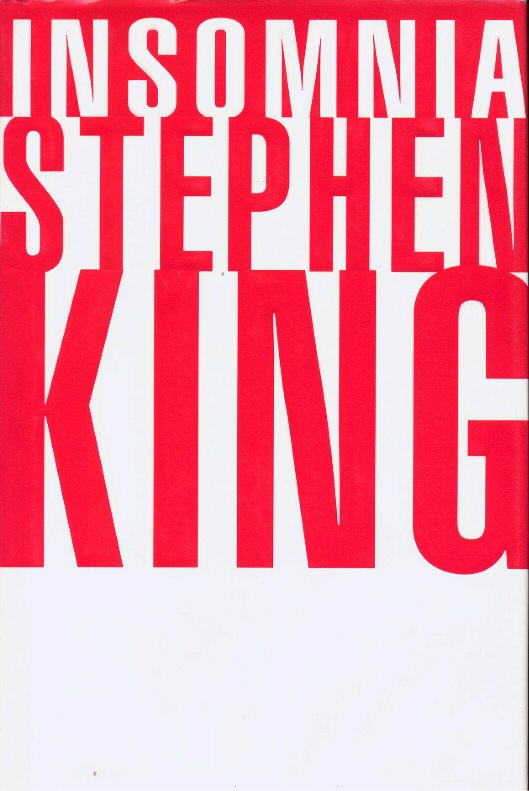
Insomnia is a difficult novel to assess. While its heft shouldn't put off Stephen King devotees, it is not as accessible to casual readers as, say, It or The Stand, even at hundreds of pages beyond Insomnia's length. Its opening pages move slowly, creating a deliberate, off-kilter feel unlike any of King's other novels. While not dull, the opening sequences (with one startling and effective action sequence near the beginning of the novel) seem to meander without direction. The cover itself - a garish red and white featuring only King's name and the title with no illustration - is forbidding. It is as if the very structure of the book - both as a story and an object - is trying to induce in the reader the sense of unreality that King's main character, widower Ralph Roberts, suffers through as he loses more and more sleep. Add to all this the fact that Insomnia is King's first "mainstream" novel dependent in part on knowledge of his Dark Tower series (as would later books Hearts In Atlantis and, to a degree, From a Buick 8 and The Colorado Kid), and Insomnia seems almost to resist being read by regular, non-fanatic readers.
And yet: after this meticulous construction of Ralph's life early in the novel, Insomnia expands. Ralph and his friend Lois Chasse begin to see what Ralph thinks of as "auras," emissions of brilliant light enclosing every person and thing. A slender stem of this light - a "lifeline" - rises from the heads of people and animals. During one night of premature waking, Ralph glimpses out his window to see two small, bald men who look like doctors enter one of his neighbor's houses with a giant pair of scissors. The next day, his neighbor is dead of heart failure.
Here, Insomnia picks up its pace. If the opening of the novel is a rumination on age and death, the book now becomes an exploration of purpose. The Little Bald Doctors are supernatural creatures Ralph and Lois call Clotho, Lachesis, and Atropos, after the names of the three Fates. Their function, indeed, is to sever the lifelines of all living things, serving the purposes of Life, Death, Purpose, and Random (what the doctors explain as the four constants of existence). In a broader context, these four constants are inherent to King's fiction. The concept of higher purpose versus free will has long interested King, playing out as central conflicts in The Dead Zone and It (not coincidentally, Insomnia is also set in Derry, the former home of It, eight years or so after the events of that novel); King would later look more directly at this struggle in Desperation, The Green Mile and Duma Key.
An imminent pro-choice rally, headed by abortion rights activist Susan Day, has divided the town by political and ethical lines, much as Castle Rock was divided by the upcoming church bingo event in Needful Things. Here, King approaches the pro-choice/pro-life issue judiciously, never letting his authorial voice take a side. Much of Insomnia tackles contemporary topics - feminism, spousal abuse, and homophobia among them (this latter most interesting, specifically addressing the murder of Adrian Mellon in It) - without allowing the novel to become mired in them, broaching them only in service to the plot. One interesting sequence involves Ralph attempting to save a group of feminists who resist him because he is a man; later, they are decimated by a pro-life extremist they trusted because she is a woman. Unlike in Gerald's Game or The Tommyknockers, the issues are not black and white, and King never seems to be soapboxing; Insomnia is served well by showing, not telling.
Clotho and Lachesis enlist the help of Lois and Ralph to intercept Susan Day's rally in Derry. Again, the book takes pains not to take a stance, instead explaining that the reason for interference isn't the rally itself, but instead a boy named Patrick Danville. Without Ralph and Lois, Patrick will be killed at the rally; according to Clotho and Lachesis, Patrick's death would disrupt the fabric of existence. Combining the philosophical questions of Greater Purpose and Higher Powers with such current hot-topics as domestic violence and abortion risks an agenda, but Insomnia works more subtly than that (though the fact that Ralph and Lois are charged with saving a young boy's life during a pro-abortion rally is interesting). Here, the novel is folded into the larger fiction of the Dark Tower novels. The doctors explain that Patrick is meant to save someone who is critical to the well-being of the Dark Tower - and, by extension, existence - itself. Patrick would later appear in the final novel of the series, The Dark Tower; the success of that novel is tied directly to his appearance, and is less rewarding without having read Insomnia. Conversely, even though a working knowledge of the Dark Tower books is important to fully understanding Insomnia, it is not as crucial as the other way around (similar to the more approachable Hearts In Atlantis).
The final battle recalls that of It: Ralph battles with the great supernatural threat The Kingfisher (aka The Crimson King, who will become increasingly important in the ongoing Dark Tower series) that actually makes a reference to the creature It and closely mimics Its powers. Other creatures bearing similar abilities - such as Ardelia Lortz from "The Library Policeman" and Dandelo the psychic vampire from The Dark Tower - suggest that there is a larger race of such beings, and that Ben Hanscom may not have killed all of Its children. Ralph must also contend with the Crimson King's human counterparts just as the Losers Club was forced to fight Henry Bowers and his friends; whereas supernatural entities are bound by the rules and strictures of magic, human beings are not, making them potentially more dangerous. In a final echo of It, Ralph is assisted by The Green Man, a mythic force for good, reminding readers of The Turtle who explained the cosmic nature of It to Bill Denbrough.
Like some of King's other complex novels (The Talisman and Needful Things among them), Insomnia is a book that rewards a re-read. It is never a difficult read; unlike books such as Black House or Wolves of the Calla, it does not require dogged persistence and concentration in its opening chapters before yielding its more accessible pleasures. As with his following novel, Rose Madder, King draws from ancient mythology for his story, but as he had repurposed and contemporized the classic Cinderella story for Carrie, Bram Stoker's Dracula for 'Salem's Lot, and Dr. Jeckyll and Mr. Hyde for The Dark Half, here he makes the references fresh and approachable; the reader never gets bogged down by allusions to the source texts. King's main characters are written well, and the details of their lives and their predicaments are involving. While we are drawn into the familiar world of Derry, Maine and the compelling stories of the people in it, the initial concern is that the book isn't really going anywhere. A second read of the novel allows for a surer conviction of its purpose, making Insomnia an even more enjoyable experience.