| The Green Mile |
|---|
|
|
Publication Information
|
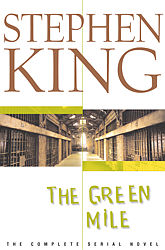
In 1996, Stephen King challenged the publishing world by choosing to release his new novel, The Green Mile, in installments: one thin paperback a month for six months. Hearkening back to a time when writers like Charles Dickens would publish novels serially in magazines, The Green Mile was a gimmick and an experiment - not just for publishing, but for King himself. When the first installment, "The Two Dead Girls," arrived in bookstores, King had not yet finished writing the finale. If writer's block struck suddenly, or if the public didn't respond to the story, The Green Mile would have been one of King's most colossal failures.
Fortunately, The Green Mile proved to be one of Stephen King's most powerful novels to date. Part One introduces us to Paul Edgecombe, the block supervisor for Cell Block E, Cold Mountain Penitentiary's death row in 1932. Paul and the other guards refer to Cell Block E as The Green Mile, the linoleum floor "the color of tired old limes." At the end of the Green Mile sits the electric chair, known as Ol' Sparky, whose presence is central to nearly every character and motivation in the novel; in keeping with the old-fashioned storytelling and method of publication, "The Two Dead Girls" includes a frontispiece of the chair, underscoring its importance.
We also meet the Green Mile's newest prisoner, a gigantic black man known as John Coffey, convicted of raping and murdering two young girls. In his first interactions with Paul, he says, "I couldn't help it, boss," which Paul initially takes as an admission of compulsive guilt. However, like "redrum" from The Shining and various titles such as The Drawing of the Three, Misery, Rose Madder, and especially Bag of Bones, the phrase has more than one interpretation; John Coffey's meaning reveals itself later, and changes the scope of the novel.
In its tone and time period, The Green Mile recalls "Rita Hayworth and Shawshank Redemption" from Different Seasons, but from there the similarities diverge. Paul explains that it is his duty - and that of the guards under him - to keep the inmates of Cell Block E comfortable and calm. These men are far more nuanced than those in "Shawshank," richly drawn characters with fully realized lives and consciences. It is necessary to believe in Paul and the men under him in order to sympathize with them - not a small feat, given their occupation.
Cleverly, King gives readers a villain in over-privileged guard Percy Whetmore, for whom cruelty and vanity come naturally. King goes to great pains to make Percy more pathetic than evil; while he is not necessarily relatable, he is not an outsized human monster along the lines of Norman Daniels in Rose Madder or Big Jim Rennie in Under the Dome. Shading Percy with humanity, however selfish and unthinking, allows us to be shocked when his actions turn accidentally grisly. The segment "The Bad Death of Eduard Delacroix" features the only truly horrifying sequence in the entire novel, and one of King's most gruesome ever. As a result, Percy goes from mean but pitiable to monstrous, and the final actions against him seem justified.
As magic realism comes to define Rose Madder, it also plays a part here. The revelation that John Coffey is a healer comes quietly and with little fanfare (in ways similar to the general acceptance of John Smith's visions in The Dead Zone, or the way Dennis and Leigh accept Christine is haunted when faced with no other choice). Certainly Paul and the other guards are shaken by the knowledge, but it is more the repercussions of the knowledge with which they are concerned. Coffey's magic heals Mr. Jingles - the eponymous "Mouse on the Mile" from Part 2 - and cures Paul Edgecombe's urinary tract infection, both extraordinary acts whose long-term impact is felt throughout the novel's final pages.
Part of John Coffey's magic involves imparting visions: one such proves to Paul, and the readers, that Coffey is innocent. John Coffey's circumstantial ties to the double murders - as well as the almost random nature of the true murderer - further recall Andy Dufresne of "Rita Hayworth and Shawshank Redemption." While the truth about Andy presents little more than an inconvenience to the warden of Shawshank, to Paul Edgecombe, the truth is devastating. Already likable, Paul here emerges as one of King's most compassionate characters yet. One of King's great strengths is making his heroes as compelling as his villains, if not more so (especially in cases like The Stand; even King's most fascinating bad guy, Randall Flagg, is less interesting than the burgeoning relationships and rebuilding in the Denver Free Zone). Though fundamentally good and righteous, Paul never comes across anything more or less than human.
As Gerald's Game seemed to signal the beginning of King's fascination with women's concerns (a thread continuing through Dolores Claiborne and Rose Madder, and to some extent, Insomnia), The Green Mile marks the start of a series of stories examining the nature of God. One of his more obviously symbolic names, John Coffey - J.C. - is understood easily as an analogue of Jesus Christ. When Paul and the other guards discover Coffey's miraculous nature (as well as his innocence), they balk at executing him; a short scene in which Paul decries his job as an excuse for killing Coffey "a gift of God," Paul laments) is particularly effective. That Coffey wants to die is unexpected yet understandable, counterpointing Paul's own wish to die by the end of the novel. Coffey's execution interprets the Catholic Stations of the Cross, with Paul standing in for Simon of Cyrene, helping to ease Coffey's burden. In the later Desperation, King would similarly translate both the feeding the multitude and the acceptance of the Eucharist in secular settings. While both novels involve God and religious symbolism, King is careful to allow these symbols to also work on surface levels. In much the way that knowledge of Gothic fiction isn't necessary to understand early work like 'Salem's Lot or The Shining, here the religious aspects illuminate the text, rather than define it.
The Green Mile's takes on race are interesting. In ways, John Coffey recalls King's early interpretation of black people as messiah figures, rather than fully-realized characters. In The Stand, Mother Abigail even fulfilled a similar religious role as a modern-day incarnation of Moses. Dick Hallorann in The Shining plays the role of the savior, subverting his own goals in service to a white family. In later novels, black characters became more complex and human: Mike Hanlon's race isn't even mentioned until halfway through It. Gert Kinshaw and Dorcas of Rose Madder both help white characters, but they are more defined by gender than race. Susannah Dean literally merges from other, less realized personalities to become whole. However, insights into Coffey's character - such as his fear of the dark - serve to humanize him, and a scene involving a racist reporter makes clear both King's and the novel's stance on predjudice and bigotry.
The Green Mile is structured ingeniously. Due to the nature of the monthly installments, King felt it necessary to include a summation of sorts at the beginning of each new chapter. In lieu of a straightforward explanation (or "Argument" to use the Dark Tower parlance), King weaves this into an analogous, "current" narrative: Paul's tenure in a nursing home during his remaining years. By making this storyline instantly compelling in its own right, King is able to hide the fact of its function. Reading the book as it was initially published, in segments, this framing device reminds the reader what has gone before and prepares him or her for the current installment; a straight-through read, however, does not seem jarring or repetitious.
Carefully drawing parallels between Paul's past and present, King eventually shifts the focus of the story. The sixth segment, "Coffey On the Mile," initially focuses on Coffey's execution, then expands into an elegy for every death in Paul's long life. In ways recalling Stella Flanders's walk across "The Reach" in Skeleton Crew, this final installment becomes a litany of the dead; unlike Stella, however, Paul himself is not allowed the release of death. Whether Paul's seemingly eternal present is penance for killing John Coffey is left up to the reader to decide. While The Green Mile is rarely grim, its finale is quiet and sorrowful, one of King's most effective endings to date.
An instant triumph, The Green Mile managed to place each of its six installments in the number one spot on the New York Times Paperback Bestseller List. At one point, all six segments were featured on the list, leading to a change in the way the Times ranks serialized novels. The runaway success of the novel inspired other writers like John Saul and V.C. Andrews to attempt serial fiction, with diminishing results. The novel went on to inspire a film adaptation by Frank Darabont, who had previously filmed The Shawshank Redemption; The Green Mile is only the second Stephen King adaptation to be nominated for Best Picture.
Though initially a publishing experiment, The Green Mile is ironically one of Stephen King's most cohesive books. While serious and thoughtful, the book also showcases King's trademark humor, a necessary asset in a novel with such an ostensibly grim setting and the looming presence of the electric chair. As definitive to King's canon as The Shining, The Stand, It, and Misery, The Green Mile not only achieves those novels' depth and resonance, but in some ways exceeds them.