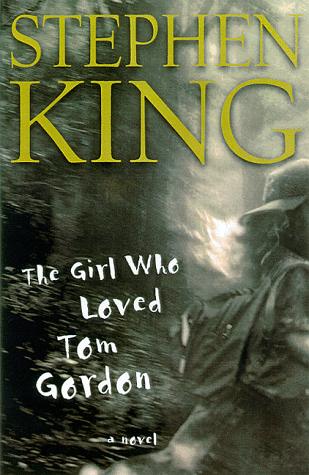
| The Girl Who Loved Tom Gordon |
|---|
|
|
Publication Information
|
One of Stephen King's most straightforward narratives, The Girl Who Loved Tom Gordon is a propulsive experience. A little girl named Trisha McFarland, walking with her mother and brother along the Appalachian Trail, steps off to get away from their constant bickering. Deciding to take a shortcut on her way back to the path, Trisha becomes suddenly and inexorably lost in the woods. For nine days, she remains lost, with nothing but her strength of character and her rudimentary knowledge of the woods keeping her going.
One of King's most enduring interests is characters in isolation. Exploring this theme metaphorically in his earliest books - Rage, Carrie, 'Salem's Lot - King soon grew more literal, as with his three characters trapped inside a hotel in The Shining. Societies are often cut off from the outside world, by weather (Storm of the Century), supernatural means (The Tommyknockers, The Regulators, Under the Dome), or both ("The Mist"). King narrowed his focus to largely two characters in the claustrophobic Cujo and Misery, while Gerald's Game experimented with a single character handcuffed to a bed. By nature, books like these succeed or fail on the strength of the people in them; strong, fascinating characters are required to keep the story interesting. While Jessie Burlingame in Gerald's Game is marginally compelling, the book's focus on her emotional baggage is far outweighed by her more fascinating battle inside and against the literal handcuffs.
Trisha McFarland, on the other hand, is an extraordinary character to follow. Her self-awareness, a common trait among King's child characters, grounds her, making her instantly relatable. Her initial moments of becoming lost - and realizing she is lost - are among King's most tense, recalling Paul Sheldon's gradual awareness that Annie Wilkes is dangerous in Misery. Her terror and emerging panic are palpable, at once cementing the gravity of her situation and underscoring her age.
Once the reality of her predicament hits home, Trisha proves remarkably capable. Her tenacity, despite her many obstacles, is fascinating and admirable (it’s no mistake that the tape in her Walkman is Tubthumper, whose most well-known song states, "I get knocked down, but I get up again / you're never gonna keep me down.") She rations what little food she has with her; when that is gone, she forages for food she knows is edible in the forest, at one point fashioning the hood from her poncho into a fishing net. She follows streams and rivers, believing that water will most likely lead to people. At night, she makes rudimentary shelters to protect herself from the elements. Her almost uncanny ability to follow a straight line may be what eventually saves her life. In ways, The Girl Who Loved Tom Gordon is reminiscent of The Long Walk, Trisha drawing on wells of strength and endurance with which Ray Garraty would be familiar; her later struggles against exhaustion and depression read much like The Long Walk's final pages.
However, despite her resourcefulness and often keen insights, we never lose sight of the fact that Trisha is only nine years old. She will eat tadpoles, for instance, but not until they're dead, for fear that they will continue to grow into frogs in her stomach. At one point, she allows herself a temper tantrum on the floor of the forest, realizing on some deeper level that she is staving off real panic and terror because of it. Cleverly, King offers Trisha (and the reader) small respites from the hours of journeying and fighting for survival: her wide-eyed wonder at a meteor shower and a colony of beavers translates easily, seeming as magical to a "town girl" as the flying men seemed to Jack Sawyer in The Talisman.
Trisha's main "out" of the reality of the woods are the Red Sox baseball games she picks up on her Walkman, especially ones featuring her favorite pitcher, Tom Gordon. Her only link with the outside world, the baseball games are nearly as vital to Trisha's survival as finding water to drink and food to eat. Tom Gordon, already her idol, grows to nearly mythic stature during her journey through the woods. At first Trisha merely imagines him; as the days wear on and she grows more and more disconnected from the world, she actually begins seeing him.
The real Tom Gordon (this is the first case in which King has used the name of a real person in a title) would point to the sky after the final out of a successful save, indicating his faith in God. Trisha latches onto this as well, counterpointing it with a conversation she had had with her father about a concept called "the Subaudible," something of an equivocation of faith. This continues a trend beginning in The Green Mile and continuing on through Desperation and, later, Storm of the Century. While God and religion are not necessarily as crucial to the story as in those other works, Trisha's nascent belief system provides another necessary motivation for her to continue looking for a way out.
Beyond the realm of the knowable - however strange and alien to Trisha - the woods also contains something else, what Trisha initially thinks of as the "special thing" and comes to call The God of the Lost. This unseen presence stalks Trisha's progress, leaving remains of slaughtered animals behind it, possibly with the express purpose of frightening and dispiriting her. Sequences focusing on this presence are among the book's most unsettling, especially when Trisha finds she cannot shake the feeling of it watching her, or blink away its murdered leavings, as she can with most of her other hallucinations. Her final face-off with this creature near the end of the book is reminiscent of the Loser's Club's final confrontation with It. In the earlier book, the reader must content with It's final shape as that of a Spider - in spite of its size and cosmic repercussions, the finality of that shape somewhat undercuts the largely shapeless horrors that define It's character. The revelation of The God of the Lost as a bear nearly evokes a similar reader reaction - its real terror comes from not seeing it - but the fact that even Trisha thinks of it (at least initially) as "just a bear" allows us incredulity while still keeping us in the story.
Unfortunately, King here feels a need to assert the bear as something - perhaps - supernatural, or at least having supernatural qualities. (One wonders if it was a conscious decision to have this bear resemble the giant at the start of The Waste Lands.) An earlier dream of Trisha's (featuring three spirits in robes, one with a face made of wasps) seems to reinforce the supernatural, as does her prophetic vision of Tom Gordon near a fence post - one she eventually finds. As with nearly all King works whose main thrust isn't the paranormal - especially Cujo, Dolores Claiborne, Gerald's Game, and Blaze - the supernatural elements here come across as distractions. While the fact that King equivocates on the exact nature of the bear and Trisha's Wasp-Priest dream could have something to do with Trisha's own perceptions (both as a young girl and as someone at the end of her endurance), it also indicates that the supernatural aspect seems at odds with the rest of the story.
Regardless, The Girl Who Loved Tom Gordon is a fast, exciting read, one of King's swiftest narratives. King writes with an economy of phrasing, never allowing the book to get bogged down in unnecessary details; anything that interferes with the novel's forward momentum seems to have been excised. Occasionally, we see details of the outside world - how Trisha's parents are reacting, an almost superfluous red herring involving a child molester - but these bits are short and don't complicate the story. Even more interesting are King's geographic insights, allowing readers to see the few times Trisha steps wrongly (her refusal to cross yet another swamp, for example, sends her further away from civilization), and to sympathize with her plight on a secondary level. As with most of King's fiction about baseball, he keeps the jargon to a minimum, allowing readers who aren't sports fans to understand the excitement of the game without getting lost in the technical details (as with the later Blockade Billy; his nonfiction, such as "Head Down" and Faithful is somewhat more impenetrable).
A surprise release at the time of publication, The Girl Who Loved Tom Gordon seems somewhat dwarfed by the more ambitious projects King released around the same time. Bag of Bones, Hearts In Atlantis, and On Writing are major works in King's canon, with Storm of the Century - one of King's two published screenplays - a unique oddity. However, as with Dolores Claiborne and several Bachman novels (Rage, The Long Walk, The Running Man and the then-unpublished Blaze), The Girl Who Loved Tom Gordon is almost all story, the type of straightforward, powerful narrative King doesn't often attempt in his novel-length works.