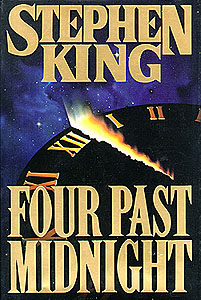
| Four Past Midnight |
|---|
|
|
Publication Information
|
The story structures featured in Four Past Midnight will not seem new to Stephen King fans; unlike the departure of the previous novella collection Different Seasons, the selections in Four Past Midnight are firmly rooted in the horror genre. Each tale echoes fiction that has gone before it, with instantly recognizable situations, making each story immediately accessible and immersive. However, though King is treading on familiar ground, Four Past Midnight remains uniquely its own entity, the majority of its novellas startling and fresh, proving once again that King has a terrific ability to derive new experiences from old ideas.
While the novellas approach horror from vastly different angles - science fictional, supernatural, and psychological - they all revolve around the theme of the past in some way catching up with the present. In this way, Four Past Midnight achieves cohesion unusual in short fiction collections. As with the previous collections of short work Different Seasons and Skeleton Crew (and the later Just After Sunset), the tales in Four Past Midnight are arranged in such a way that the pace and sweep resemble that of a novel.
"The Langoliers" executes one of King's most ambitious science fiction concepts: the idea that time is a finite, tangible thing that must be disposed of as it passes. The sleeping passengers aboard American Pride Flight 29 awaken to find themselves in a barren, dead world that looks like ours but is fundamentally altered. Food tastes stale. Sounds don't echo. Gradually, they come to realize they have somehow flown into the past, and that the past is nearly used up. There is also a sound on the horizon - a crackling, crunching sound - hanging over the characters and the story, representing an unseen menace serving to underscore the smaller horrors before presenting itself in the climax.
The situation is reminiscent of "The Mist," a connection made unmistakable by the chapter headings (King refers to these titles as "old fashioned [and] rococo" in the introduction to the novella). In place of the religious mania of Mrs. Carmody, we are introduced to Craig Toomey, an unbalanced man with a pathological fear of laziness. Unlike with Mrs. Carmody, however, we actually sympathize with Toomey a little, as King allows us into his back story that explains some of his psychoses and urgency. Here, King returns to the subject of monstrous parents that so fascinated him in his early novels. Roger Toomey is in line with Henrietta Dodd, Margaret White, and Al Marsh: manipulative, abusive parents whose actions directly affect the often tragic outcomes of their children's lives.
It is through Toomey that King first introduces the twin themes of time and pressure, and what happens when pressure disappears. In many ways a dark twin of Andy Dufresne from "Rita Hayworth and Shawshank Redemption," Toomey reacts to pressure destructively, eventually driving himself to murder and inadvertent suicide.
The classic King archetype of the Child With Special Powers (The Shining, Firestarter, Carrie) returns here in the person of Dinah Bellman, a blind girl granted with some telepathic and "push" powers. The compact format of the novella doesn't allow King to explore Dinah's talents in much depth, which actually works for the good of the story. While Dinah herself is sympathetic and interesting, her powers exist to move the plot along and bring about the denouement. "The Langoliers" once again proves that the novella might be the best showcase for King's work: long enough to create complex situations and believable characters, but without the level of detail and subplots that occasionally hinder King's longer works.
If "The Langoliers" finds King again working with the tale of disparate people trapped in inexplicable jeopardy (beyond "The Mist," King would return to this type of story in Desperation, The Regulators, Under the Dome and, to some extent, Cell), "Secret Window, Secret Garden" returns to one of King's more recent fascinations: writers and their relationship with writing. This second novella figures as part of a loose trilogy of writer's stories, preceded by Misery and The Dark Half. The later Nightmares & Dreamscapes story "Umney's Last Case," the novel Bag of Bones, and the final volumes of the Dark Tower series would continue this angle of interest, with almost uniformly interesting results.
"Secret Window, Secret Garden," concerns plagiarism - hardly the stuff horror stories are made of, but again King has a knack for making the mundane seem at once fascinating and horrifying. Bestselling novelist Morton Rainey is confronted by a man named John Shooter who implacably insists that Rainey plagiarized one of his short stories. Mort's published story "Sowing Season," he claims, is a copy of his own "Secret Window, Secret Garden." The more Mort asserts that he hasn't, the more dire the situation grows. Mort's cat is murdered. His house is burned down. And systematically, all proof that "Sowing Season" is Mort's is destroyed.
Reminiscent of The Dark Half, "Secret Window, Secret Garden" is skillful at making internal terrors external, heightening the tension and excitement of a story whose basic premise seems dry. Further, King's adeptness at making the private lives of writers relatable to the average reader remains impressive; his countless bestselling writers from Maine rarely seem like Stephen King analogues or inaccessible millionaires. Again, King makes use of the symbolic name Mort (meaning death, last seen in The Drawing of the Three), and allows John Shooter a catchphrase - "You stole my story" - as direct and horrifying as Misery's "I'm your number one fan." An examination greif, guilt, and the motivations of creative people "Secret Window, Secret Garden" is one of King's most thrilling shorter works.
Along the same lines, "The Library Policeman" is one of King's most horrifying stories to date. Once again, King begins from a ludicrous starting point - the idea that menacing Library Policemen will come after those with overdue library books - and twists it into terrifying execution. At the center of the story is a creature analogous to It, an alien being who can read peoples' minds and actualize their worst memories. Sam Peebles, who has lost his overdue library books, is forced to relive his worst childhood memory in a terrifying sequence anticipating the central childhood horrors in Gerald's Game and Dolores Claiborne. In effect, "The Library Policeman" succeeds almost too well, generating a sense of unease and dread throughout unmatched by anything King has written before or since.
Unfortunately, "The Sun Dog," the final novella of Four Past Midnight, suffers from King's excesses. A supernatural camera whose pictures develop to reveal the titular, murderous Sun dog is a sound, if bizarre, central object, somewhat recalling Skeleton Crew's "Uncle Otto's Truck" as a slowly advancing killer. The theme of compounding guilt and sins of the past - touched on to various degrees in each of Four Past Midnight's novellas - is interesting, furthering the questions of children paying for the sins of their parents found in Firestarter, The Talisman, and It, and more directly in Bag of Bones and Wolves of the Calla. But the novella is simply too long, miring itself in irrelevant details that bring the momentum to a standstill. While "The Sun Dog" features a fairly chilling finale and provides a bridge between The Dark Half and Needful Things as the last group of stories set in King's Castle Rock, it unfortunately is one of King's less successful novella-length attempts.
While Four Past Midnight flirts with (and forwards) themes integral to King's career, one gets the sense that Four Past Midnight is simply Stephen King having fun, emphasizing story, pacing, and mood over thematic concerns. While none has had the same impact on King's larger career as the tales in Different Seasons (though "Secret Window, Secret Garden" comes close), these novellas are almost uniformly entertaining, exciting, and well written, and as such, may be a good place for new readers to begin.