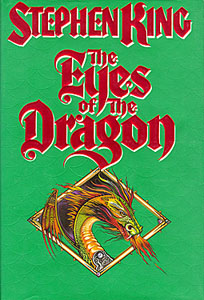
At first glance, The Eyes of the Dragon seems a stunning departure for Stephen King. Eschewing the "real world" entirely - including references to popular media and brand names - King immerses the reader into a fully realized fantasy world. As he had done with science fiction in The Running Man, King creates a credible alternate reality, complete with its own jargon and locations. Meaning the book to be "heard" - as if told aloud - King refers to himself as Storyteller within the text, utilizing mythic, fairy-tale language like "happily ever after" and "since time out of mind." Indeed, the title page insists that Dragon is "A Story by Stephen King," rather than a novel. Initially written for his daughter, who had no interest in his horror novels, The Eyes of the Dragon does read like a novel written for younger readers. However, like many other fantastic works intended initially for children (such as Alice In Wonderland, Winnie-the-Pooh, and the Harry Potter series), The Eyes of the Dragon can be read and enjoyed by adults, as well. King stated, "I respected my daughter enough then - and now - to try and give her my best ... and that includes a refusal to 'talk down.' Or put another way, I did her the courtesy of writing for myself as well as for her."
As unique as Dragon seems initially, however, those familiar with King's larger canon will notice similarities to his other works. Flagg, the novel's villain, is referenced as early as the first page ... whether an earlier or later version of the same creature from The Stand is up for the reader to decide. Peter, the wrongly imprisoned prince, shares deep similarities with Andy Dufresne of "Rita Hayworth and Shawshank Redemption," not only in his intention of breaking out of prison but in his method of doing so. Indeed, much of Dragon seems borrowed from the earlier novella, recontextualized for a fantasy setting. The advantage Dragon has over "Shawshank" is that we are witness to the things that have shaped Peter; despite its real-world setting, "Shawshank" paints Andy Dufresne as more mythic than Peter seems.
Peter's discovery of a locket and a letter from a long-dead prisoner recalls Jack Torrance's discovery of the Overlook's scrapbook in The Shining, and prefigure both Annie Wilkes's scrapbook of murder in Misery, and Mike Hanlon's scrapbook of Derry in It. (A more explicit reference to that book comes late in Dragon, in reference to Flagg: "it was a monster chasing them, some horrible It." While it seems unlikely that King means to indicate that Flagg and Pennywise are one and the same, it is interesting that King is willing to draw comparisons between them.) Weather, often an important facet in King's work, is essential to the book's dénouement. The snowstorm that wreaks havoc through the Kingdom of Delain brings to mind the similar storm in The Shining (not to mention that of the later Storm of the Century); its destructive nature anticipates the final storm in It, in which the destruction of the Standpipe at the end is reminiscent of a tower's collapse here. Similarly, smaller elements borrow from King's other novels, such as the dogs'-point-of-view sequences from Cujo. These thematic connections would later grow more literal, as King would fold the world of Dragon into the larger universe of the Dark Tower books.
Unusually, The Eyes of the Dragon doesn't rely on action for excitement. While a dragon is slain early in the novel, much of the hunt is "off-screen," told about rather than shown. During Peter's imprisonment - a long, static situation that King manages to make interesting, as in similar situations in Firestarter - the Kingdom of Delain nearly falls into ruin, and beheadings become commonplace. Again, these things are spoken of rather than shown, seeming to go against basic storytelling credos. As with most of King's books, however, the real stories are found in the characters, not the plot. While the characters in Eyes of the Dragon are, by design, more basic and less developed, their interactions and relationships are as complex and fascinating as those in King's other novels.
Early sequences featuring Peter and his mother, Sasha, define his character. Prefiguring It, The Eyes of the Dragon allows us to watch the progression of child to adult, specifically showing how lessons learned by Peter young benefit him in critical situations. King Roland's relationships with Peter and his brother Thomas have direct repercussions as well; Roland admits - at least to himself - to loving Peter more. This, even more than Flagg's interference, devastates him, making him one of King's many child characters damaged by his parents. In vital ways, Roland's murder is as direct a result of his actions toward his children as Margaret White's in Carrie's, or Regina Cunningham's in Christine.
King initially released The Eyes of the Dragon as a sumptuous limited edition through his own Philtrum Press. An oversized hardcover with a printing of only 1,250 copies, this edition features illustrations by Kenny Ray Linkous and thick paper stock the quality of fine linen - a tactile connection to the royal napkins so important to the book's narrative. (In fact, the original title of Dragon was The Napkins, both titles demonstrating King's ability to define the central images in his novels.) In an essay titled "The Politics of Limited Editions," King explains why he had chosen to publish certain books in limited runs, stating that he didn't think his general public would like such books as Dragon, or Cycle of the Werewolf, or The Gunslinger. Three years later, however, King would bow to public pressure, releasing a lightly revised edition to the mass market, incorporating new illustrations by David Palladini. This edition relied heavily on King's extant reputation as a horror writer - in a move reminiscent of the advertising of The Talisman as a horror novel, the paperback advertised "terror" and "the darkest depths of fear." However misleading, the tactic worked, with both the hardcover and paperback reaching #1 on the bestseller lists ... proving that, at the height of his popularity, Stephen King could publish in any style, in any genre, and people would buy it.