![]() |
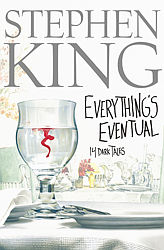
Everything's Eventual:
|
“Here’s some more short stories, if you want them.”
This is the opening line to King’s second short story collection, Skeleton Crew, and they worked so nice then, I thought I’d bring them out for an encore. Since 1985 (when Skeleton Crew was first compiled), King has been through quite a lot. He descended into addiction and clawed his way out. He was nearly killed walking along the side of the road near his summer home. His kids have grown up, and his audience has, too. But still:
“Here’s some more short stories, if you want them.”
That seems to be the one constant in the world of Stephen King. More stories, year after year. Here’s another famous Kingism: “Here, sir, there are always more tales.”
These stories aren’t new to me, by the way. Because I’m Mr. Fanboy, I’ve picked up every issue of The New Yorker featuring a new work by King. I bought Blood & Smoke when it was released only on audio (same thing with the live recording of “L.T.’s Theory of Pets.”) Heck, back in ’96, I plunked some good money down on King’s self-published Six Stories, and put myself ahead of the game by six years on almost a third of Everything’s Eventual. I’ve gotten emails from readers of this site, stating the same thing, and asking me why King would put out a new collection of only old stories. Is he trying to cheat us, or something?
Here’s the short answer, in two parts: 1. If you’re that much of a King fan to have read and bought all that stuff as it came out, you’re most likely going to re-read the stories. Why dig out your old copies of Fantasy & Science Fiction from their carefully sealed Mylar bags when you can simply open the new mass-produced hardcover from Scribner? Go ahead, smudge it up while eating your Chee-tos! Leave those collectables fingerprint-free! 2. Are we all forgetting the 90% of the population who doesn’t read every King story the second it hits the stands? The general buying public, even if they consider themselves fans, is waiting for the new book. Most have probably never heard of any of these stories (except maybe “Riding the Bullet”), let alone read any of them. To those who have, yes, feel a little envious of that 90%. After all, they are getting a new Stephen King book. But don’t cheat yourself. Reading King’s stories in a collected format is a wholly new experience, and one which even avid readers shouldn’t deprive themselves of.
It’s interesting going back to some of these at this late date. If you match up their copyright dates with the novels that were published around the same time, you’ll start to see certain similar themes emerge. For example, King kicked off a whole series of novels exploring different facets of religion in the mid-nineties, starting with The Green Mile, and cycling down around the time Storm of the Century was broadcast. In this collection, you’ll find “The Little Sisters of Eluria” (a Dark Tower tale that actually works on its own, for the most part) and “That Feeling, You Can Only Say What It Is In French,” both drenched with religious imagery. A lot of these tales deal with death, and it’s interesting to see the way that the subject is dealt with more shocks in tales like “Autopsy Room Four” and “L.T.’s Theory of Pets,” as opposed to the more serious look at the consequences of death in “Riding the Bullet” and “All That You Love Will Be Carried Away.” Those later stories were written after King’s near-death experience, and it shows in both the tone and the choices of their main characters. It seems, in the later tales, that King is taking a harder look at his own mortality, and letting his characters do the same. Either way, it makes for great storytelling.
That’s not to say everything in this collection works. Nothing in Everything’s Eventual is as bad as, say, “The Ten O’Clock People” from Nightmares & Dreamscapes, but there are some stories which seem to have lost their way. In particular, “The Death of Jack Hamilton” and “The Road Virus Heads North” are two stories that don’t seem to fit in very well. “Jack Hamilton” is a fictional re-creation of true events, but to those readers not familiar with the actual history, the point of the story is lost. As for “Road Virus,” King seems to be deliberately treading into self-parody. Reading the short story (featuring yet another bestselling writer from Maine), I became convinced that King was simply picking up bits of past stories and tossing them in the blender and seeing what comes out of it all. I have no problem at all with King reusing old ideas; there aren’t that many original ideas in the world, anyway. But King has always had a talent for taking those old ideas and making something new out of them (perfect case-in-point: the pyrokinetic Charlie McGee having to follow in the footsteps of King’s telekinetic Carrie White.) Here, the recycling seems blatant and threadbare. It’s Rose Madder crossed with Christine, and it doesn’t work all that well.
Of special note is the order of the stories in this collection. King states above the table of contents that he chose the order based on how he pulled playing cards out of a deck. While this makes for an amusing “wow-isn’t-Stephen-King-crazy” tale, it only works against Everything’s Eventual. King’s collections have always worked better than most because the stories are positioned to be read like a novel. The beginning story is usually something epic, and different (see Night Shift’s “Jerusalem’s Lot,” told in the Lovecraftian style, or Skeleton Crew’s novella “The Mist,” or even Nightmares & Dreamscapes’ mad Poe tale “Dolan’s Cadillac.”) The finale is usually quiet and understated (respectively, “The Woman in the Room,” “The Reach,” and King’s best poem, “Brooklyn, August.”) The middle ground is open for battle, with like stories often paired (N&D’s “Popsy” and “The Night Flier” work exceedingly well together).
The frustrating thing here is that the collection, good as it is, could have been even better if the order hadn’t been arbitrary. A large tale like “Everything’s Eventual” or even the popular “The Man in the Black Suit” should be first (as it is in Six Stories). Stories exploring similar themes like “That Feeling” and “Luckey Quarter” or “The Little Sisters of Eluria” and “Autopsy Room Four” should be matched up in the middle. And “All That You Love Will Be Carried Away,” a beautiful dream of a tale, belongs in that final position, carrying the reader off with a whisper.
Ah, well. All these would haves and should haves are detracting from what’s good here; there’s much to love in Everything’s Eventual. Regardless of the order, the majority of King’s “14 Dark Tales” are terrific. Some of his scariest moments ever exist in “Autopsy Room Four” and in “1408” (which works on paper almost as well as it does on audio.) I like how the joy and fun at the beginning of both “Everything’s Eventual” and “L.T.’s Theory of Pets” tumble down into the darker depths that King is famous for by the end. Stories like “That Feeling, You Can Only Say What It Is In French” and “The Man in the Black Suit” have even more impact on the second (or third) read, sinking deeper and staying longer. Regardless of the detractions, Everything’s Eventual is a hell of a collection; the title story and “All That You Love Will Be Carried Away” alone are worth the price of admission.
Also cool: every story comes complete with either a forenote or an endnote by King, discussing the story in greater depth. Knowing that King himself didn’t care much for the popular and award-winning “The Man in the Black Suit” is quite revealing, and getting King’s take on a complex story such as “That Feeling” sheds new light on things. For those fans interested in knowing the “whys” behind the stories, this is the book for you.
King states in his introduction that he doesn’t necessarily like writing short stories anymore, but he does at least one or two a year to keep the short-story muscles flexed. All we can do if give thanks for that. I love the novels, and always will … but knowing that tales like “1408” and “The Man in the Black Suit” exist makes me happy that King hasn’t turned his back on these smaller stories completely. Everything’s Eventual is solid proof that Stephen King is one of the best short-story writers in the world today … even though, in the shadow of the novels, this is publishing’s best-kept secret.
Riding the Bullet
Stephen King has always told tales in which there are actually two stories going on. The first one, the one up-front, is the one that the book banners tend to fixate upon. This is the Stephen King who writes about werewolves and vampires and cars that come alive and kill. It's easy enough to harp upon that Stephen King. The supernatural isn't seen as "literary," regardless of the precedents set by Shakespeare and Dickens.
But the second story, intrinsic to almost everything King has written, is what is happening beneath the surface: the subtext. Sure, It was about a monster that murdered children, but its true story lay in the coming-of-age of seven kids, and the adult world they would eventually inherit. This is where King excels, and why readers come back again and again. In the subtext, King explores vaguer and more universal issues such as faith, guilt, love, and loss. The horror stories involve themselves with events that transcend everyday life; the thematic strings that hold those stories together, though, are the exact representation of everyday life. Balancing these two elements has made King both the American Boogeyman, and the Spokesman for the Common People.
In recent years, King has sought to weave both the text and the subtext closer together. In his more recent novels, Bag of Bones, The Girl Who Loved Tom Gordon, and the novel-as-anthology Hearts in Atlantis, King has brought his understanding of everyday people to the fore, blending the horror with the drama more readily than ever before. The new novella, "Riding the Bullet," perfects this new direction, understanding at once that there is no room for secret meanings here. What lurks beneath can no longer be hidden.
This urgent tale begins with Alan Parker, a college student at the University of Maine. One day, he receives a phone call from home: a neighbor informs him that his mother has had a mild stroke. Panicked, Alan comes on the run, planning to hitchhike the one hundred twenty miles from Orono to Lewiston, Maine, where his mother might be dying. At this point, all Alan is concerned about is what will happen when he gets to the hospital. He doesn't stop to consider the journey ahead of him, and how his life will change because of it.
To reveal too much of the actual story would be like cheating. "Riding the Bullet" is not exactly original, but in its particulars it becomes as engrossing as any of King's best fiction. I will say that on the way to Lewiston, Alan is asked to make a wish, and to make a decision. The wish comes true, but the outcome of his decision is more hazy. Alan believes that his decision is a matter of life or death, and perhaps that's true. But the ending of this taut tale leads one to believe that it is really a matter of guilt and responsibility. Do we really understand the sacrifices our parents have made for us, or do we focus on how they hurt and hindered? When it comes down to it, does Alan Parker care more about what his mother gave up for him to go to college, or how she smacked him on the back of the head once at an amusement park?
Amid all this, King still manages to deliver one hell of a horror story. Written directly after the auto accident that nearly killed him in July of 1999, King must have had death and cars on the brain. Delivering a tale like this is a testament to King's dogged determination to keep writing, and keep digging. The term "riding the Bullet" refers to a ride in an amusement park in New Hampshire, the Bullet being an upside-down roller coaster that sends its passengers screaming into the air. In the story, Alan Parker once chose not to ride the Bullet, walking away from those terrified passengers flying through the air. Whether his choice was right or wrong - or, in the end, reversed - is ultimately up for the reader to decide.
Stephen King, however, has chosen to continue riding the Bullet. And if this story is any indication, he doesn't appear to be stopping anytime soon.
Luckey Quarter
Darlene Pullen is down on her luck. She is a motel chambermaid who wants to get braces for her daughter and a Sega system for her son. The last straw in her day is finding a tip in her envelope in room #322. The tip is a single quarter, and a note that goes with it:
"This is a luckey quarter! It's true! Luckey you!"
Angry and a little hysterical, she takes the quarter to a slot machine in the lobby of the motel. Unbelievably, she hits the jackpot -- eighteen dollars. She takes these earnings and goes to a local casino. She keeps winning, but feels it's somehow wrong. The more she wins, the more the "luckey quarter" stays with her. As she is about to place her highest bet, she shakes out of her daydream. Her children Patsy and Paul stand there, waiting for Mom to get off of work. Paul is sick again. Darlene hands him the luckey quarter and he puts in the slot machine. She knows, with dull horror, that everything will happen to him just as she dreamed it. She will be rich, but she won't be free of the quarter.
Little is made of the reasons why losing the quarter is so important. Once again, King's characterization is astounding. But the story, though fun and a little exciting, is ultimately confusing. And what's with the spelling?
Autopsy Room Four
The best sheer horror story in the collection, "Autopsy Room Four" is a terrifying trip through the mind of someone who may or may not be dead. The narrator, Howard Cottrell, is wheeled into Autopsy Room 4 in Derry, (!) Maine. He's been pronounced dead as result of a heart attack on the golf course by one of his doctor friends. Howard tries to breathe hard enough for someone to notice he's not dead, tries to hum so they will hear him, but the autopsy doctors have turned on The Rolling Stones full blast. Panicked, he begins to believe that he really may be dead. Then, he remembers the snake on the golf course. The snake in the rough.
"Autopsy Room Four" really freaked me out. The ending - which should be a cop-out but isn't - sets up the punchline in the epilogue, but this isn't an "L.T.'s Theory of Pets" humor story. Several passages in this short tale are some of King's most terrifying, questioning the very fabric of the afterlife before crashing down into painful, horrifying reality. "Autopsy" is linked, thematically, to its companion tale "The Man in the Black Suit," about a fatal bee sting, but this is really its own story. Tense, disturbing, and really, really freaky, this remains one of King's best short stories.
L.T.'s Theory of Pets
Story Review
"If your dog and your cat are getting along better than you and your wife you better expect to come home some night and find a Dear John note on your refigerator door."
This is L.T.'s theory of pets, and it's a true one. L.T.'s wife leaves him one day in the described manner, not because she doesn't love him, but because she has to move on. L.T. is famous for telling the story of their unraveling marriage, likening them to their pets: Frank, a Jack Russel terrier who belongs to his wife, and Lucy, a Siamese cat who belongs to him. The pets become representative to what each spouse wants from one another. L.T.'s admittedly amusing story doesn't continue to the fact that Lulu disappeared after she left him. He tries to tell himself that she has become a singer in Vegas, or, worse, a prostitute. But that is better than what he (and the narrator, L.T.'s friend) really suspects: a serial killer known as the Axe Man has killed her. Her car was found with her dog Frank's blood and bones in it, but Lulu was missing.
One of the stories here with a nonconclusive ending, "L.T." is still a formative story. L.T. is a great narrator, funny and insightful, but we also see the side of him that cannot joke about his wife's disappearance. I'd like to see a conclusion to this, but maybe it's better left in our imagination.
Audio Review
Listening to the live recording of LT’s Theory of Pets is, at first, a bit disconcerting. I’ve been listening to audiobooks read by King for nearly a decade now (my first – and arguably my favorite – was The Drawing of the Three), and never before has he had a live audience in the background, reacting to what he’s saying. The first time I heard the audience laughing at something King had said, I jumped a little. Aren’t these supposed to by my reactions, alone?
But as I listened, something strange happened. The laughing and clapping became less a distraction, and more a welcome surprise. As I trotted down the street to work or headed home from the train station one day, there was the full audience in my head, enjoying this reading as much as I was. The feeling became communal, in a way, as if I was somehow sitting in one of the seats at the Royal Festival Hall in London, watching Stephen King read from the podium.
When I first read this little tale in Six Stories lo those many years ago, it wasn’t one of my favorites. The humor in the story made me smile – King rarely fails to get a chuckle out of me – but this was at a time when I felt that King was trying to write in other genres and felt himself dragged helplessly back into horror. Yes, I know, I was like one of those mainstream critics who bemoan, “We know you can write quality work, Mr. King, so why do you keep slumming?” I forgot the old King adage: Why do I assume he has a choice?
Either I’ve risen above the jading (as I think I may have; I’m more into King right now than I have been in the last four years), or the audio of LT’s Theory of Pets simply made me appreciate the story more. This has happened twice in the past, with Needful Things and The Gunslinger – stories I didn’t much care for at first, but whose audio versions made me fall in love. With LT now a part of my audio collection, I can definitely see myself bringing it down off the shelf everytime I need a laugh … or a scare.
Lunch at the Gotham Cafe
Beware: Spoilers!
A surreal, insane little story, "Lunch at the Gotham Cafe" is an excercise in lunacy. It starts off sadly, yet normally. A man named Steve Davis comes home to find his wife gone and a Dear John note on the table. He goes through a stage of depression, and abruptly decides to quit smoking. Her lawyer contacts him and sets up a lunch date -- one, which it turns out, his lawyer won't be able to attend. Waiting to go into the Gotham Cafe, he buys an umbrella he doesn't need. Then, he enters.
That's when the fun begins.
The maitre d' appears disheveled, his tie askew and a strange dried-blood stain on his shirt. After he brings Davis to his table to meet Diane and her lawyer Humboldt, he goes insane. Shouting at the top of his lungs ("YOU CAN'T BRING THAT DOG IN HERE! EEEEEEEE!"), he proceeds to hack up Humboldt. Davis takes his ex-wife and runs. The maitre d' continues screaming about a dog and its incessant barking as he chases Steve and Diane into the kitchen, wounding a chef nearly mortally. The two barely escape, but Steve gets the idea that Diane wanted him to die at the hands of Guy the maitre d'. He says incredulously "I saved your life!" She replies, "No, you didn't."
In the face of such behavior after the preceeding insanity, Steve begins to wonder how the maire d' went insane. He imagines a dog across from Guy's apartment, barking to no end. He compares it to his situation with Diane, and begins to say, softly: "Eeeeeee. Eeeeeeee. Eeeeeee."
This is how the story ends, Steve tumbling helplessly into associative insanity. It's a strange little peice of fiction, well written and well characterized. Still, the ending leaves one feeling empty, and Diane's bizarre behavior seems a little unreal. Other than these minor flaws, this is a good story, especially when coupled with the previous "L.T.'s Theory of Pets."
The Man in the Black Suit
This is the story which won the prestigious O. Henry Award, the award for the best magazine-published short story of the year. It deserves it, although I feel a little sad for some earlier stories that also deserved it, but didn't get it.
This story has a lot of those familiar "typical King" touches. Most of it takes place in Castle Rock and the Kashwakamack township is mentioned often. It's a story of a boy in the nineteen-twenties who, the previous year, lost his brother to a fatal bee sting. At the time of the story, the boy (named Gary) goes up to Castle Stream to fish, and comes across a man with blazing orange eyes wearing a black suit. Gary comes to the conclusion that this is devil, and is so terrified that he wets his pants. The man in the black suit tells him that a bee has gotten his mother, too, and that he will take Gary away from that sorrow by eating him.
This horror show is too much for Gary, and he throws a gigantic fish he caught at the man, who gobbles it down. This distraction frees Gary enough to run away.
Gary wins the short but scary chase, and when he returns home he discovers that his mother isn't dead. The devil is a Master of Lies.
Years later, at eighty years of age, Gary is looking back on this memory, still scared. (In fact, Gary recalls Paul Edgecombe of The Green Mile in both his age and his slow, cautious speech.) In "Sun Dog"-like style, he wonders if the Man in the Black Suit is still hungry.
One of the best stories here, "The Man in the Black Suit" is well worth the award it recieved, and reccomended.
Everything's Eventual
King has stated in various interviews that he's only had "two or three original ideas" in his many years of taking old plots and putting new spins on them. "Everything's Eventual" is one of those stories that hinges on completely original ideas, and it makes you wonder why no one else thought of them before.
Dinky is your typical Gen-Xer, stuck in a nowhere job and living with a mother who doesn't appreciate or even like him much. His job at the local supermarket is rife with hazards, most in the form of a bully named Skipper, who likes to chase after Dinky with shopping carts. Except one day, Skipper meets with a very bad end ... and we learn that Dinky's not your typical Gen-Xer at all. He has a certain talent, a way of drawing certain indescribable shapes, that drive people to suicide once they look upon them. Dinky, a thinking, moral individual, is bothered by this "gift" ... until he is contacted by a governement agency called Transcorp who wants to weild it for themselves.
Sounds kind of like a retread of Firestarter, huh? While there are shades, this story is so far out of the realm of that novel that to compare the two would be an excersize in futility. The meat of this longish tale deals with Dinky's internal struggle, and while that in itself is fascinating, where King does it best is in the details. The house Transcorp sets up for Dinky is a consumerist's dream come true, and King sprinkles the details so joyously here that we begin this story really happy for Dinky. (My favorite bit is the Dinky receiving the autographed picture of Nicole Kidman on her Moulin Rouge swing, a detail King updated for this anthology.) I love how the atmosphere of this story starts out sunny and a little silly, and gets darker by gradations until its chilling finale. Much like "L.T.'s Theory of Pets," the amused and amusing beginning foretells the later darkness only in its subtext and clever plot mechanations. Also, check out the dual nature of the title, something King has made into sort of a specialty (Rose Madder is a prime example). The slang term means, for Dinky, "everything's cool" ... but when we look at the actual words, we notice a different truth. Covering the collection like a tent, the title speaks volumes: death, pain, repetition: everything's eventual, and nothing is as it seems.
Speaking of "L.T.'s," King has stated that that story and "Everything's Eventual" were the only two in this volume that came easily to him. Reading this story, it's obvious that the tale just flowed out of King, rolling lazily at first, then churning, and finally catapulting you off into the abyss. What a terrific story.
That Feeling, You can Only Say What It Is in French
The Death of Jack Hamilton
Harlan Ellison is famous for saying that most King works - save for It and The Dark Tower series - could be told just as effectively as a novella. I disagree with this assessment, with a few reservations (Gerald's Game, for one; Dreamcatcher for another.) King's often excessive length allows him to sketch characters with a depth and understanding he wouldn't be able to capture in an artificially shortened tale.
Which brings us to "The Death of Jack Hamilton," which feels like such a tale. Instead of the novel that should be a novella, it's the short story that should be a novel ... or a novella at least. In trying to tell a slightly epic story in short form, King has dismissed most of what makes his stories so good.
"Jack Hamilton" has no bang. It's not a badly written story, that's obvious. There's no significant problems with the characters, really; they have the requisite number of conversations and quirks that make them a little more than characatures. The character that stuck out most for me was Rabbits. King makes the most of his space here to sketch her out and make her fully real to the reader, something he isn't quite able to do with his main characters. I quite enjoyed meeting her and thought she belonged in a better story. But that's the most frustrating thing - this isn't a bad story. It's no "Ten O'Clock People" or "Road Virus Heads North." It's just got no bang.
Two cases in point: At the beginning, Homer sets up the mystery of Dillinger, and sets a good pace for a story. He says, "That's what I want to tell you about: how Dillinger got the scar on his upper lip."
Bam, right there - classic opener of a King story! What we're expecing here is a rip-roaring yarn told by one of King's "old parties," in that distinctive voice that he has. But no. What we get is a somewhat bland shootout and a somewhat bland followup. Sure, the set peices are nice: I liked the scene in the car with the family and all the stuff in Rabbits' gang's area. But that's all they are - scenes, sequences that don't resonate. The story of the scar isn't the highlight of King's story at all - in fact, it seems more an afterthought than anything.
Case in point #2: The trick with the flies. Ever since Hamilton mentioned it, I was really looking for it to be something really cool. And, granted, when Homer started doing it, I was amazed. But then ... it went nowhere. Leashing flies is kind of neat, and the bullet killing one of them was also pretty intriguing, but there's nothing beneath the set peices.
Maybe you have to be a Dillinger Gang nut to truly understand all the implications here. Maybe there's something to the ride with the family, the gunshot that hit a fly, the gang of theives rallying around one of their own who is dying. They all seem like legend-makers to me, only this story doesn't do much to flesh out the legends. It doesn't do much fleshing at all, actually, and that's a bit of a disappointment. If King wants to write historical fiction (faction?) that's perfectly fine with me. I will read anything he writes. But here, I wasn't sure why these unconnected details were so important, why I was supposed to care so much. I found myself far more interested in Homer's prison life, to be honest, and how he first met up with Dillinger and Pierpoint, and how he learned the trick with the flies. The present was well-written, and at times compelling ... but not really what I was interested in.
Much of King's writing is interconnected, newer works referring back to previous works, but we never lose a sense of background, place, or reference in what we're reading. Here, King seems to be doing the same thing, but without giving us any meat to gnaw on; his interconnection here is with history books, and those not familiar might feel a little lost here.
I would love to read a revision of this story, something heartier. That beginning is classic and the last few lines are King as his elegaic best. It's the middle that's the problem here. There's simply not enough of it.
The Little Sisters of Eluria
The Road Virus Heads North
"The Road Virus Heads North," is the latest in a string of stories King has written in the 1990's focusing on inexplicable events that happen for no reason. Stories like "Luckey Quarter," and "That Feeling, You Can Only Say What It Is In French," were both tales of random bizarre events occurring to people just because they did, with no impetus. "Road Virus" carries on King's new experimental style while also paying homage to one of horror's classic formats: the comic book.
"Road Virus" begins with a man named Richard Kimmel, a (what else?) bestselling horror author from Derry, Maine who stops at a yard sale in Connecticut and buys a painting named "The Road Virus Heads North." The painting shows a dangerous-looking man and his menacing car by the side of a road, just the type of picture Kimmel loves. He buys it, puts it in the trunk of his car, and begins his drive back home.
When next Kimmel opens his trunk, he sees the painting has changed, and slowly he comes to the realization that the man in the painting is real … and that he is being followed.
"Road Virus" is an odd, incidental little story. None of the events seem really connected to each other - even when the events are grounded in reality, the entire tale seems as surreal as "That Feeling." One can almost read it with comic-book panels in mind - characters and events are painted with broad strokes. While entertaining, "Road Virus" is a slight, somewhat boggling story that makes the reader wish there had been more.
In the Deathroom
A man named Fletcher is sitting in what he knows to be a torture room in the basement of a South American Ministry of Information. He has secrets his captors want ... but he refuses to give them up. The man interrogating Fletcher, a genial, smiling person named Ramon, continues to offer Fletcher a cigarette. Fletcher knows that it will be his last unless he can somehow find a way to escape. Spurred on by the mind-numbing jolts of pain the torture device emits, Fletcher desperately hatches a plan that will either free him ... or kill him.
"In the Deathroom" is an odd type of story for King. He doesn't set his work outside Maine much, let alone the country (as in "Crouch End"). At a crucial point in this tale, the action switches to New York City, where the other two Blood & Smoke stories take place. In additon, Fletcher is very reminiscent of Steve Davis of "Cafe'" and Mike Enslin of "1408," all three of them desperate men whose lives are suddenly turned inexplicably upside down, and who must rely on their own strengths to free themselves.
"Deathroom" oddly recalls some of King's longer work: Cujo, Gerald's Game, Misery, and The Girl Who Loved Tom Gordon: all stories that build up to a certain tension level ... and somehow stay there. Will Our Guy (or Girl) escape, or will s/he die? The interesting thing about "Deathroom" is we are never sure of the outcome, or the consequences either option leaves one with.
As the last of these tales, "Deathroom" serves as a fitting coda. It's not necesarily the best of these stories, but it's eerily effective. When you read reviews of King that say "King never lets up," it's stories like this they're talking about.
1408
The number refers to a room located in a prestigious New York hotel, the Dolphin. The sequence of numbers looks innocuous enough, until you add them together and discover they equal thirteen. Your unease may grow once you realize that while room 1408 is located on the 14th floor of the Dolphin, it's really the thirteenth floor. Hotels worldwide eliminate all mention of a thirteenth floor due to superstition ... a superstition Mike Enslin should perhaps believe more in.
Enslin is a writer of "true ghost stories" books, always touching on the thrill of the supernatural tabloid America craves, but never believing in the paranormal himself. He comes to the Dolphin doing research for a new book, this one on the subject of haunted hotels. The hotel manager, Mr. Olan, takes Mike aside, trying to persuade him to stay out of 1408. Mike scoffs at first, but as Olan delves deeper into the odd, horrific history of the room, Mike listens closer. For room 1408 is no ordinary haunted room, if any such rooms could e called ordinary. Even if you escape its clutches, it never exactly leaves you.
I won't go into what happens to Mike once he enters room 1408. To do that would be to spoil the surprise. Let me say this, though -- several scenes (such as the phone call scene) work extremely well on audio (as heard originally on the audio-only collection Blood & Smoke). I'm not sure that that scene (and a few others) translate from the page as effectively. Kudos to King for choosing this story for his audio book. This was definitely the right medium for it.
"1408" is a terrific addition to his growing work of short fiction. As with Bag of Bones, King takes the timeworn idea of hauntings and turns it on its head. Unlike that novel, however, King has little time to waste with explanations and musings. What the reader gets instead is one horrific little story, scary almost from the beginning.
Final note: a device used on the audio version is extremely effective. Near the end, during a particularly tense section, a saxophone screeches out a short note, followed by an extended coda. It's that short note, though, that'll have you jumping out of your skin. Listen for it: it works real good.
All That You Love Will be Carried Away
King's first 2001 publication is, in its own quiet, unassuming way, quite a remarkable debut. A few months before his much longer, much more bombastic tale of terror Dreamcatcher, "All That You Love Will Be Carried Away" is a lonely story of desperation and tentative hope. It tells the tale of Alfie Zimmer, an on-the-road salesman who is just about at the end of his rope. Every road looks like an endless highway to him now, and the perfect family tableaux he imagines others experience will always be out of his reach. At the point where his family and a possible better future aren't enough to keep him alive, Alfie grabs hold of the one thing he's really been living for: a notebook full of graffiti he has copied from restroom walls and under bridges across the country. He sees greater depth in these random phrases, and in the places they have come from; if he is gone, who will decipher them?
“All That You Love Will Be Carried Away” is such an affecting short story, with a main character so idiosyncratic that he becomes easily relatable to the average reader. One might see one's self preparing to bite the bullet ... and realizing that they have just one thing they can't bear to part with. The ending - which is unresolved - is one of King's most powerful, without leaving the feeling of loose threads that "The Road Virus Heads North" did.
This is a new type of voice for King, one even more subtle than the one he used in the Hearts in Atlantis tale "Blind Willie." In this reviewer's opinion, King's more recent short fiction has been spotty: often brilliant ("1401"), sometimes disappointing ("The Road Virus Heads North"), and sometimes just plain bizarre ("That Feeling, You Can Only Say What it Is In French.") "All That You Love Will Be Carried Away" is one of the brilliant ones, and one of King's best fictions to date. Hyperbole doesn't do this story justice, but I'll try anyway: King needs to win another O. Henry award for this one, or something even more prestigious. This is the type of tale that proves that King is the best writer of our time.
2001 News
1. Riding the Bullet
2. Luckey Quarter
3. Autopsy Room Four
4. L.T.'s Theory of Pets
5. Lunch at the Gotham Cafe
6. The Man in the Black Suit
7. Everything's Eventual
8. That Feeling, You can Only Say What It Is in French
9. The Little Sisters of Eluria
10. The Road Virus Heads North
11. In the Deathroom
12. 1408
13. All That You Love Will be Carried Away
The big surprise here is "Little Sisters," which - for those who don't know - is a prequel to The Gunslinger, and which ties in explicitly to Black House. (Also, I'm pleased as punch that "Carried Away" will finally see a book printing. This is indeed one of King's very best fictions to date.) THANK YOU J NOLAN!!!
The history of this book's publication has been crazy. Rumors abounded all over the internet as to when it would come out, what its title would be, etc. The waiting is over, kids: the book will not be called Road Kill or One Headlight. Instead, the title comes from King's amazing novella Everything's Eventual, which is one of the 17 stories in this 500+ page collection.
So far, the only stories that are confirmed are "Everything's Eventual" and "L.T.'s Theory of Pets," but below I've made some educated guesses (and hopes) as to the rest of the roster. My hope is that there will be some new tales in this one, but you just never know with King.
So, there are your stats: over 500 pages, 17 short stories, two confirmed titles, and a March 2002 release date. YEY!!!
2000 News
King stated in his afterward to the paperback version of Bag of Bones that when he was planning the short fiction collection between Bones and On Writing, he envisioned a book including a lot of unpublished material, plus some stories that had made magazine appearances. Then, he wrote a story called "Hearts in Atlantis," which eventually led to the linked tales that comprise the upcoming book of the same name.
While he was deliberating on what to include on the collection-to-be, however, King came up with a title: One Headlight, after the Wallflowers song. Do we know what will be in this collection? No. Do we even know if the collection is in the works? We know that production of it has been at the very least postponed. When and if the collection ever does come, will it still have the same title? Probably not. King changed the title of Hearts in Atlantis three times before settling on the current title.
So, why does this page even exist? Think of it as part alternate-universe page, part future truth page. We know King will release another collection; that much is a fact. What will be in it, however, is a matter of supposition and rumor, and that, my friends are why we're here. Let's postulate some guesses!
So, what might be in the upcoming Everything's Eventual? Here are some educated guesses:
The Definites
1. "Everything's Eventual" -- One of King's best stories ever; plus, he mentioned it specifically in the Bag of Bones afterword.
2. "Lunch at the Gotham Cafe" -- Also mentioned in the BOB afterward.
3. "L.T.'s Theory of Pets" -- a live-reading favorite, this funny story is a sure thing
4. "Autopsy Room 4" -- appeared in Six Stories and Robert Bloch's Psychos. One of King's eeriest stories, and a new fan favorite.
5. "The Man in the Black Suit" -- Winner of the O. Henry Award, this literary achievement is definite.
6. "Luckey Quarter" -- The first of King's odd surrealist stories, a mini-sub-genre King explored in the late 90's.
7. "That Feeling, You Can Only Say What It Is In French" -- Another of the surreal stories that also contains heavy religious imagery, another theme King worked with in the 90's.
8. "The Road Virus Heads North" -- a campy novelette featured in the anthology 999; not my favorite of King's works, but probably a sure thing.
9. "Ride the Bullet" -- The e-book sensation
10. "All That You Love Will Be Carried Away" -- King's seminal short story featured in an early 2001 New Yorker. One of King's best tales, and a fine addition to any collection
The Possibles
1. "The Little Sisters of Eluria" -- this Dark Tower novella would seem out of place in a collection of his "regular" stories, but it's possible he'll include it.
2. "1408" -- this great little tale about a haunted hotel room in New York City has to be included: I'm going o say it's King's best short since "Everything's Eventual." Found in sound format only on Blood & Smoke.
3. "In the Deathroom," -- the other audio original on Blood & Smoke, about an interrogation room, and the price of freedom.
4. "Leaf-Peepers" -- King included his nonfiction piece "Head Down" in Nightmares & Dreamscapes, so why not this essay (originally published in The New Yorker)?
Probably Not, But Wouldn't It Be Cool?
1. "The Cat from Hell" -- why why why isn't this story collected yet?
2. "Squad D" -- damn you, Harlan Ellison, release the rights to this!
3. "The General" -- a short screenplay that recently appeared in the anthology Screamplays. Hey, King collected, "Sorry, Right Number."
4. "The Hardcase Speaks," or any of King's uncollected poetry.
5. "An Evening at God's," the one-minute play King auctioned off and never collected.
6. "Night of the Tiger" -- not King's best, but his first story in Fantasy & Science Fiction, so it's historically important.
Let's not forget King has also mentioned that he has a bunch of entirely unpublished works. Let's see what else he can toss our way...