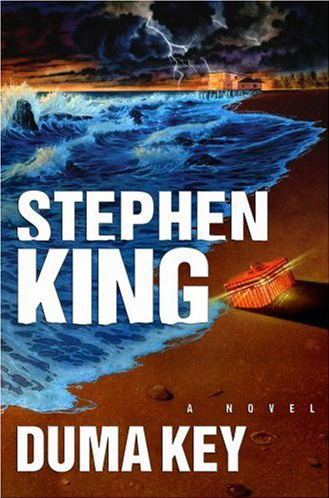
| Duma Key |
|---|
|
| Publication Information
|
While Bag of Bones is a darkly emotional novel, though, Lisey's Story seems emotionally distant. Perhaps that is its intention, forcing the reader to feel as crippled by Lisey's grief as she herself does. While Lisey's Story contains some of King's best writing, and some passages within it are compelling (especially the flashback sequences), the front-story never seems all that involving. This is partially why Duma Key is such a surprise.
Chuck Verrill, King's longtime editor, explained that King sees Duma Key as a mirror to Lisey's Story: "‘You know how Lisey's Story is a story about marriage?" [King] said ... ‘I think Duma Key might be my story of divorce.'" This is perhaps misleading. The central flaw in Lisey's Story is that its main focus - indeed, its main character - is a dead person. Scott Landon, Lisey's husband, is the force behind that novel, and unfortunately Lisey's story is simply not as compelling as Scott's is. (This storytelling structure fared better in From a Buick 8, where both main narrative and the back story were equally interesting.) Lisey and Scott Landon's marriage is the core of Lisey's Story, binding Scott's pre-Lisey days and Lisey's post-Scott days together. While divorce impacts Duma Key, it does not define the novel, the first of many crucial differences between the two books.
Edgar Freemantle, a successful contractor, is severely injured on the job. His hip is crushed and he loses his right arm (perhaps another interpretation of divorce). More importantly, he loses his memory. Not all of it, though: slowly, painfully, it comes back to him. The process, often verbally and sometimes physically violent, estranges his wife Pam and she leaves him. On the verge of suicide, Edgar takes the advice of his therapist and attempts a geographic cure: taking off from the frosty winter of Minnesota to the relatively balmy island community of Duma Key, Florida. Then he starts to draw.
This quiet, almost reflective beginning opens into one of King's most involved narratives. The surface story seems almost standard: it's a ghost story of sorts, about the way the past (and the tricky burden of memory) has a way of slipping its bonds. As a horror story - even as a relatively gentle horror story - it works, and works well. There are enough rotting corpses and colossal reptiles and shrouded figures with silvery eyes to satisfy the type of popcorn thrills readers experience in a novel like Cell. But like the best of King's work, it works on an even more satisfying secondary level: once again, King is exploring the concept of creativity, and its will on the person who wields it. It's a well King has drawn from many times, most notably in It, Misery, The Shining, The Dark Half, and Bag of Bones; in all those books, King has stuck with writing as his primary source of exploration. Here, King focuses on visual art, painting and sketching, and uncovers even more layers to this career-long obsession.
In Misery, Paul Sheldon finds himself removed from the distractions of his everyday life, and finds that he can summon ten to twelve pages a day without breaking a sweat. While King seems to praise this sort of output - which transcends work ethic and edges into compulsion - in later works (The Dark Half, "Secret Window, Secret Garden," Bag of Bones) and his nonfiction work On Writing, he seems to argue for a balance between life and art. Never does this seem more vital than in Duma Key, in which King openly questions whether that type of singular devotion to creativity is necessarily a good thing. King's fascinations are at work again, the questions of whether creativity isolates creators, and whether the art or the artist is more important. When King raises these questions, he seems to be asking his stories for answers. What makes Duma Key so effective is that the story doesn't attempt easy solutions. Characters decide their own answers, and as with his best novels, King's authorial voice remains understated.
King's character work is particularly strong in Duma Key. Edgar Freemantle (a distant relation to Mother Abigail Freemantle, from The Stand?) is one of King's better-drawn people; he has quirks and flaws, habits and idiosyncrasies. He admits to loving one of his daughters more than the other, but has the good grace to feel bad about it. In the midst of the story, which rarely slows once Edgar arrives in Florida, King takes the time to quietly bond Edgar to the people around him. His relationship with his daughter Ilse is sweet and kind and unforced - a nearly awkward father-daughter conversation by a pool is a highlight - and his friendship with his neighbor Wireman recalls that of Red and Andy Dufrense from "Rita Hayworth and Shawshank Redemption," or Louis Creed and Jud Crandall from Pet Semetary. King's handle on adult male friendships has grown stronger with time (especially in Dreamcatcher), and is in top form here. Edgar's relationship with his ex-wife Pam is the sort of complicated, nuanced relationship King first perfected between Bobbi Anderson and Jim Gardener in The Tommyknockers: sometimes sweet, sometimes wicked, all very real.
Starting with Bag of Bones and continuing through the latter segments of The Plant, King began experimenting with a new genre: the mystery-horror. The ghost story at the heart of Duma Key is as frightening as any of King's more visceral horror novels (and its use of nautical imagery, unusual for King, recalls the stories "Something to Tide You Over," and "The Raft"), but is structured in mystery-novel conventions. Other echoes of Bag of Bones proliferate here, too: that novel's Gothic feel comes naturally to King's Florida setting, and the initial more gentle horrors (and, perhaps unintentionally, the gruesome and surprising death of a young woman who forms the emotional center of the main character) as well as the focus on creative, damaged people point to Bag of Bones as Duma Key's true precursor.
As with The Shining, The Stand, Desperation, The Regulators, and scattered others, Duma Key takes place outside of King's comfort zone of Maine; as with those other novels, King's narrative seems energized by this change of scenery. The then-recent chase story "The Gingerbread Girl" - King's first story set in Florida - benefited from the new location; unfamiliar with the landscape, King's eyes are fresh and wondering, the writing itself feeling less experimental and more vital than his prior short stories. In the same way, setting Duma Key in Florida seems to have opened up new possibilities, resulting in a novel more emotionally focused than either Lisey's Story or Cell. Everything from the style to the story to the characters seemed to exist in perfect harmony; one wonders if Edgar Freemantle's "geographic cure" is King commenting on his own move to Florida, and the resultant approach to his fiction.