| The Dark Half |
|---|
|
| Publication Information
|
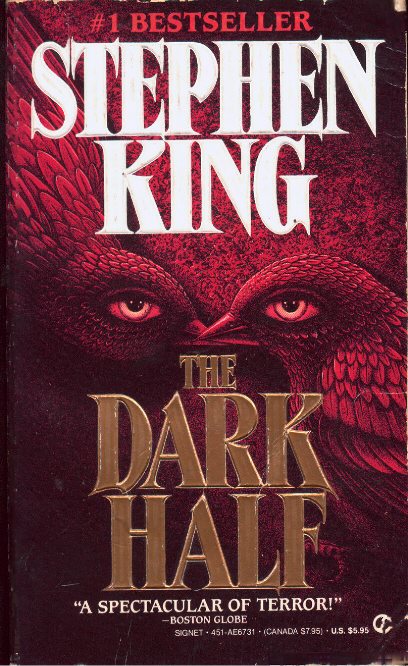
Stephen King's last novel of the 1980s, The Dark Half is a bleak, violent novel with lasting repercussions along King's canon. Concerned with matters of identity and the divided nature of writers, it is of a piece with King's more introspective works about fiction and authors - notably It, Bag of Bones, "Secret Window, Secret Garden" from Four Past Midnight, and especially Misery, with which it shares remarkable similarities. More than those other works, The Dark Half's primary question is just this: Who does a writer become when he sits down to write? Addressed first in Misery but extrapolated brutally here is the follow-up question: how fundamentally does writing change the writer?
In the essay, "The Importance of Being Bachman," King stated that The Dark Half was his way of making sense of the Richard Bachman phenomenon, how being Bachman and how being revealed as Bachman affected him. The Dark Half concerns itself with novelist Thad Beaumont, a literary writer who is beloved by critics but whose novels sell poorly. He also writes under a pseudonym, George Stark, whose sadistic crime novels are all bestsellers. At the start of the book, Thad's pen name has been discovered. Rather than allow himself be exploited by the man who discovered his secret, he goes public with the knowledge, culminating in a story in People magazine and a mock burial for Stark.
Stark, though, has other ideas about being dead. Soon after the mock burial, people connected with Stark's demise are found viciously murdered (in one of King's most horrifying sequences, an incidental character is beaten to death with his own prosthetic arm). Worse, Thad's fingerprints are found at some of the crime scenes, leading to a police investigation. Only gradually do Thad and his wife Liz come to understand that George Stark had somehow manifested into reality, and is now targeting them.
While The Dark Half may be Stephen King's most violent book, it is also - perhaps jarringly - his most cerebral. King's thoughts on writing here are fascinating, expanding largely on themes he first discussed in Misery. Like Paul Sheldon, Thad Beaumont is a successful genre writer feeling trapped by his creation. Unlike Misery Chastain, Thad's creation is the meta-fiction of Stark - like Richard Bachman, a fake person writing real books. Only, as King again states in "The Importance of Being Bachman," pseudonyms have a way of becoming real, at least to those involved in their creation. The term "pen name" is somewhat a misnomer here: to both King and Beaumont, their pseudonyms have a back story and a personality - beyond simply a name on the cover of the book, their pseudonyms achieved a rudimentary existence. Liz Beaumont knows George Stark well enough to actively dislike him; even before his manifestation into the real world, both she and Thad discuss him as if he's a real person, giving credence to both the power of Thad's imagination and the assertive, occasionally overwhelming power of fiction.
The problem with Stark's emergence into the physical world, however, is that he's not quite real enough. By "killing" him, Thad is essentially stating that he will not write as Stark any longer. But for writers, especially those whose compulsion to write borders on obsession, writing is life. In Misery, Paul Sheldon literally keeps himself alive by the need to know what comes next in the book he's working on. In The Tommyknockers, Bobbi Anderson constructs a device that allows her to write telepathically, to the point at which she is writing even in her sleep; the ship that is giving her the power to do so is, at the same time, draining her life away. George Stark may have come to life, but holding onto that life without writing is killing him. He is "losing cohesion," and unable to construct fiction without Thad's help, stressing the interdependence between author and creation. In On Writing, King argues that "art is a support system for life, not the other way around," but in George Stark's case (and maybe Thad Beaumont's) both scenarios seem true: writing cannot exist without life, and life cannot exist without writing. George Stark will fall apart without Thad, but one of the book's crucial questions (answered later in both Needful Things and Bag of Bones) is whether Thad will fall apart without George.
Stephen King's interest in the dual natures of people had been occupying him through much of the 1980s. In Cycle of the Werewolf, he touched on the basic tenets of lycanthrope fiction without really exploring them. He and Peter Straub went further in The Talisman, introducing the concept of twinners and twinning, stressing the uniqueness of a singular nature (a theme King would return to in Wolves of the Calla). In The Drawing of the Three, King introduced a character with multiple personalities - Detta Holmes/Odetta Walker - before allowing her to merge into one healthy personality. In the prologue to The Dark Half, we are witness to a sequence of visceral medical horror: surgery on a young Thad Beaumont's brain to remove remnants of a twin absorbed in the womb. It is suggested that George Stark is the ghost of that twin, allowed to survive in spirit - if not in body - in Thad's brain. In a clever bit of foreshadowing, young Thad's headaches, caused by his twin's absorbed body parts pressing on his brain, are eased when he writes.
George Stark and Thad Beaumont begin as two minds in one body; when Stark asserts his reality, they become one mind in two bodies. As the novel progresses, it becomes increasingly obvious that only one can continue to exist. Merging is not an option; only the dominant personality will be allowed to survive. In the novel's climax, the outcome is in some doubt: despite the dangers of losing his own cohesion, Thad finds himself drawn into the story Stark demands they write together. Opposing Paul Sheldon, whose novel gave him life on a variety of levels, Thad is tempted by the power of his and Stark's new book, even though following its path will inevitably kill him.
With It, King used the device of a split narrative to follow two timelines that eventually merge. The Dark Half is also split, but in this case tonally instead of in terms of story. Segments focusing on the Beaumonts' domestic life are almost comforting. King's deft hand at characterization seems effortless: Thad, Liz, and their twin children William and Wendy are drawn convincingly, even gently. The intrusions of George Stark seem written by a different hand, similar in mood and intent to books King wrote under Richard Bachman's name. In an author's note, King states that he is "indebted to the late Richard Bachman for his help and inspiration. This novel could not have been written without him." King's word choice here - indebted to - is interesting, given the nature of the novel and King's thoughts on the dependence of alternate personalities.
The Dark Half explores the themes and motifs of writing more nakedly than anywhere else in his fiction (only his later nonfiction book, On Writing, examines the internal life of authors more intensely). Without sacrificing narrative flow or losing sight of the psychological and human cost of events, King manages to expand on ideas first encountered in It, Misery, and The Tommyknockers (and later followed up on in Bag of Bones and Duma Key), resulting in one of his scariest, most effective, and emotionally powerful novels.