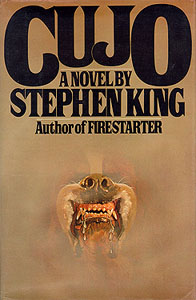
Limited Edition Information
| Cujo |
|---|
|
|
Publication Information
Limited Edition Information
|
Oh, this book is grim.
At the outset, we are introduced to small characters leading desperate lives. Vic Trenton and his partner Roger Breakstone, who own an advertising agency called Ad Worx, are struggling to save their business in the wake of an unfortunate accident involving one of their clients. Vic’s wife Donna has stumbled into a bleak affair with a local handyman, and is attempting to break it off. Their son Tad is plagued with nightmares about a monster in the closet that may not be groundless. Charity Camber, across town, lives in fear of her drunkard husband Joe, and their son Brett is prone to attacks of sleepwalking. And then there’s Cujo, the Cambers’ enormous St. Bernard, who has just contracted rabies.
A depressing outset, but at first, things seem to be getting better. Brainstorming, Vic and Roger figure out how to save their ad agency. Charity Camber wins the lottery – enough money to afford a new chainfall for her husband, and a trip to her sisters' to show Brett “how some decent people live.” Donna Trenton’s decision to end her affair with Steve Kemp has given her a new serenity and feeling of independence. Then, almost at random, everything conspires against everyone. Kemp writes a nasty note to Vic, telling him about the affair. Donna and he have a confrontation, days before Vic is needed on an away trip to save his business. Brett and Charity discover that the way her sister lives isn't necessarily the best way. And then there's Cujo, the most random and lethal element thrown into the equation.
While Charity and Brett are away, Cujo slaughters Joe Camber and his neighbor Gary Pervier. The house is left empty, miles away from other houses. While Vic is in New York, then Boston, Donna drives her failing Pinto to Camber's to change a valve. The car, of course, stalls in Camber's yard, leaving Donna and Tad trapped against the force that is Cujo -- a good dog driven insane by a degenerative nerve disorder. In the meantime, Kemp shows up at the Trenton's and trashes the place. When Vic comes to realize something is wrong at home, the vandalization throws a cog into finding Donna and Tad; the reader gets the impression that, if not for Kemp, the two trapped in the car would have been found faster.
The final hundred or so pages focus on Donna's grim struggle to keep herself and Tad alive in the sweltering heat of the car. Cujo attacks, Cujo lays low. In these last, feverish passages, Cujo becomes dangerously exhilarating - an increasingly tense stalemate where the outcome is never quite clear.
The novel's catchphrase, spoken by an Ad Worx creation, is “Nope, nothing wrong here.” This is Stephen King at his ironic best. Everything goes wrong in Cujo. The maddening thing about all this is that almost everything that went wrong could have been avoided. It's almost all coincidental. The accident involving Vic and Roger’s client. Donna’s affair. The fact that both Vic and the Cambers were away when Cujo becomes rabid. The car stalling at the worst moment. Everything.
Thus, Cujo is a troubling novel. The characterizations are terrific; if not for the appearance of the title horror, this book might have played out as straight drama. King’s writing is fine, as well. The ratcheting tension during the final scenes is the sort of thing that lends credence to the hyperbolic phrase, “white-knuckle thriller.” It’s just the way these things play out that frustrates. Too much seems random, so much so that we detect the authorial hand moving his pieces around. It is unrelentingly bleak, tonally closer to King’s Bachman novels than the majority of the books King publishes under his own name. While not necessarily a liability, the lack of any sort of hope or release in the book can be at times exhausting. There is also, alarmingly, a vague supernatural conceit that grates against the staunch realism of the rest of the book. As with King’s later book, The Girl Who Loved Tom Gordon, the bare hint of the supernatural seems hastily added and inessential, detracting from the main thrust of the story.
It is a testament to King’s storytelling ability that these problems seem minor when the novel is taken as a whole. Despite its flaws, Cujo remains an engaging read, frightening and involving and ultimately a success.