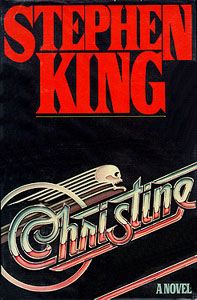
Limited Edition Information
| Christine |
|---|
|
|
Publication Information
Limited Edition Information |
Christine is often considered one of King's more minor novels - not bad, certainly, but not in line with his more ambitious novels such as It, The Shining, or The Stand. In ways, it could be considered derivative of some of King's more iconic work - the story of a high school outcast changed by supernatural means is reminiscent of Carrie, the concept of a Bad Place whose past haunts the present recalls both The Shining and 'Salem's Lot. Even the backdrop of the 1970s brings to mind the turbulent political era of The Dead Zone. Certainly the scope is narrower than that of one of King's longer novels, but that doesn't make it any less important. What King has done with Christine is taken a fairly standard storyline with fairly standard characters and made it something far more interesting than the sum of its component parts.
Christine plays to two of King's greatest strengths: making broad characters human and making the uncanny believable. The aforementioned outcast, Arnie Cunningham, is drawn with more depth and personality than his predecessor, Carrie White. Dennis Guilder, his best friend and narrator of the first and third portions of the book, notes Arnie's flaws and physical drawbacks, but is careful to underline his strengths (indeed almost reveling in the fact that he's discovered them). The small flashes of a funny, outgoing personality that seemed to emerge in Carrie at the prom - before the events triggering her rampage - are inherent in Arnie from the beginning, if only for Dennis to see. Not quite a nerd (though Arnie is smart, King seems to indicate that he wouldn't even fit in with that group), Arnie is one of King's prototypical Losers, shy and quiet and meek ... but he's also a brilliant mechanic. That these two seemingly incongruent sides of Arnie's personality should gel so easily is a testament to King's writing. Infused with a unique and quirky personality, Arnie is someone we care about and can instantly relate to, so that when the horrors begin, we can easily fear for him.
Similarly, Dennis Guilder - Arnie's best friend - could easily have come across as a generic jock. The very virtue of being Arnie's friend, and recognizing that he needs Arnie as much as Arnie seems to need him, transforms and deepens him. Further, because he acts as the narrator for two-thirds of Christine, we rely on Dennis's insights into not only the central story and Arnie's character, but for the tone and feel of the book as a whole. While Christine works as a coming-of-age metaphor, Dennis also recognizes his growing-up explicitly, expanding on thoughts and themes first voiced by Sue Snell in Carrie . In important ways, Dennis is reminiscent of Red from "Rita Hayworth and Shawshank Redemption”: in telling the extraordinary tale of his friend, he reveals his own story.
Christine's unusual structure is jarring, told from Dennis's point of view for the first and third segments, and in third person for the middle. King stated in an interview with Twilight Zone magazine that he "got into a box” with the narration. Dennis was supposed to tell the whole story, but his football accident and resultant hospitalization took him out of the action. Though the narration style changes, King states, "it's still a first-person narration ... it's just masked, like reportage.” Even still, the shift in viewpoint lends the book an off-kilter feel that only enhances the unease with which the reader approaches the story. That Dennis, who has spent the first third of the book building a sense of compassion for himself and Arnie, can be so brutally taken out of the action this early serves to remind us that the horror in this book - as in so many other King novels - can strike randomly and without warning. And once the horror starts, it is unrelenting.
Leigh Cabot, the book's (human) love interest, comes closest to caricature, described as almost ludicrously flawless. King even takes a moment to point out that writers will generally add some slight flaw to a beautiful girl, so as to add realism and to counterpoint their attractiveness; Dennis assures us that Leigh needs no such flaws. Indeed, even when we are privy to Leigh's thoughts in the middle sequence, she (like Frannie Goldsmith in the initial version of The Stand) reacts more than acts. Most of her motivations are directly linked to Arnie or Dennis, leaving her less believable than either of those two characters.
Leigh also works as a counterpoint to Christine herself. A 1957 Plymouth Fury, Christine is little more than a skeletal husk of a car when Arnie discovers her. Opposing Leigh's physical flawlessness, Christine is marred by cracks, rust, and age. Arnie sees beauty in Christine despite the outer ugliness; Arnie himself has to draw flawlessness out in her. Similarly, Leigh has seen beauty in Arnie, and imagines taking the same pride in fixing him as he is doing with Christine. The bizarre Leigh-Arnie-Christine love triangle is unbalanced and parasitic and ultimately destructive.
Arnie's obsession with his car recalls Jack Torrance's interest in the Overlook's scrapbook in The Shining, though the darkly erotic component brings to mind Harold Lauder's interest in Frannie Goldsmith in The Stand ... or, more tellingly, Todd Bowden's fascination with the Holocaust in "Apt Pupil.” Dennis makes reference to Christine's "female force,” and scenes in which Arnie is inside Christine underline the sexual subtext as well as the consumptive power of obsession. The nature of Christine herself is ambiguous; whether she is "simply” haunted by her previous owner, the sinister Roland LeBay, or inherently evil is left to the reader to decide. Christine seems to function, at least in part, like King's other Bad Places: a receptacle for negative emotion and energy. In this way, she is a microcosm of The Overlook in The Shining, or the town of Derry, in It - only movable, and likely indestructible.
Christine, King's first full-on horror novel since The Shining, is certainly scary, but horror is only part of the thrust. While the novel offers grisly death scenes, much of the horror in Christine springs from deep melancholy, with both the horror and the hope in the novel mired in misguided nostalgia. Dennis makes several references to his senior year of high school as being the end of a long, quiet era, remember what Arnie was like when they were kids, and how much better life was then. Arnie's parents only want Arnie the way he was before he met Christine: under their thumb and bending to their will. As the situation escalates, Will Darnell - owner of the garage Christine inhabits - reminisces to excess about the only good time in his miserable life. Even the villains, especially Buddy Repperton (who is the author of most of Arnie's pain before Christine appears) attempt to stay trapped in their "glory days,” remaining in high school long after they should have graduated. In this way, Christine herself becomes the ultimate metaphor: a car from a long-gone era that spontaneously regenerates, assuring a state of perpetual present. The real terror comes from the concept that things can always remain the same.
Early in the book, Dennis calls his story a tragedy; the book has a somewhat simple through-line, during which doom encroaches and then marches, implacably, toward an inevitable end. But Christine never feels as dependent upon coincidence, as in Cujo; though we sense the fates of our main characters, the payoffs never feel rote or pre-scripted. It's important to note that even after being explicitly prepared for the worst, the worst still surprises.
In King's early career, he often explored the lives of young children; later, he focused more on grown adults. Christine is one of the very few novels in which he looks at the social structures and inner lives of teenagers. With more realistic characters and a stronger narrative thrust, it is an improvement on Rage and Carrie, and its small, personal story is only bested later by the larger horrors of Vietnam in the novella "Hearts In Atlantis.”
Though not necessarily an "important" novel in King's canon, Christine provides strong characters, intense sequences of horror and terror, and a propulsive, undeniable narrative. For these reasons - as well as its success on symbolic and metaphoric levels - Christine should not be dismissed.