| Cell |
|---|
|
|
Publication Information
|
Technology has always unnerved Stephen King. Early works like "Trucks" and "The Mangler" (later collected in Night Shift) explore the horrors of machinery out of human control. Later, longer works like The Tommyknockers and The Waste Lands are more nuanced, looking more deeply at the way people interact with technology that they don't understand. Cell, King's first full-length work of fiction since the finale of the Dark Tower series, examines a different sort of technological horror: the destructive possibilities of mass communication. As the earlier novella "Everything's Eventual" utilized email as a vehicle to hypnotically suggest people into suicide, in Cell, cell phone users are suddenly affected by something known as The Pulse, turning them instantly into mindless, zombie-like creatures: primitive, aggressive, and brutally violent.
The main thrust of the story concerns Clay Riddell, a graphic novel artist and writer who has just gotten his big break before the Pulse hits. He's in downtown Boston, and the only things on his mind are presents for his son and his estranged wife, and an ice cream cone for himself. When the Pulse hits, its result is swift and bloody. A proper woman in a business suit in line ahead of him at the ice cream stand goes ballistic, lurching forward to tear the ice cream vendor apart. At the nearby Boston Common, a man suddenly turns on his dog, attempting to bite its ear off. Small and large pockets of violence erupt seemingly out of nowhere. Clay's only response is to find his son, and to ensure his safety.
Thus, Cell opens up as a quest novel, albeit more compact and with a narrower focus than The Stand, The Talisman, or the epic Dark Tower series. Clay's journey from Boston to Maine interestingly reverses the Heart Of Darkness-esque expedition at the center of King's earlier Dreamcatcher. As every one of King's novels between Dreamcatcher and Cell have taken place largely outside King's Maine, this might be read as a statement of purpose: King would return to his home turf with his following two novels, Lisey's Story and Blaze.
Clay soon bands with other "normals" not affected by The Pulse: Tom McCourt, a middle-aged man from Malden, Massachusetts, and Alice Maxwell, a teenage girl initially too terrified to approach them. These three are drawn with expert broad strokes, always seeming believable without dwelling too much on detail. This is indicative of Cell's almost leisurely writing style: though the events in this novel are compelling, even urgent, there is a relaxed quality to the writing itself, the story flowing easily from one event to the next. While the apocalyptic proceedings and quest structure seem to beg comparisons to The Stand, Cell boasts none of that earlier novel's mythic feel. More than anything, Cell reads like an action thriller, coming closest in tone and theme to the Richard Bachman novel The Regulators. While Cell deals with somewhat weightier themes and Clay's is an ostensibly optimistic story, the books share an essential nihilism absent from much of King's work. It is interesting to note that the central conflict in The Regulators stems from television - another exploration of technophobia.
King's three central protagonists represent some interesting ongoing aspects in King's evolving character work. While creative people remain integral to King's fiction, here he seems to be taking the first steps away from those people being novelists. Clay Riddell, a comic-book writer and artist, points the way toward the more richly developed artist Edgar Freemantle in the upcoming Duma Key. Alice Maxwell serves as an emotional adjunct to Clay Riddell's savior character; in this way, she recalls Mattie Devore in Bag of Bones, a young woman "saved" by the novel's protagonist, only to be brutally murdered. Indeed, Alice anticipates Edgar Freemantle's daughter Ilse of Duma Key - in both her role in relation to the male center of the novel and in her brutal murder - making these three well-drawn young women part of a perhaps unintended triptych of misfortune.
Tom McCourt is unusual in King's fiction both because he is gay, and because his homosexuality doesn't seem all that unusual. Neither Clay nor Alice care much about this aspect of Tom, representing a major step in King's treatment of gay characters. While characters such as the bisexual Dayna Jurgens (The Stand), Tommy Woodbine (The Talisman), and Bill McGovern (Insomnia) are positive - and occasionally heroic - figure in minor roles, characters such as the stereotypically effeminate Adrian Mellon (It) and the subservient Roger in The Shining seem to have been featured more prominently. The fact that Tom's sexuality is briefly addressed and accepted (and that he reads more like a person than a stereotype) suggests a culmination of King's more complex and interesting handling of gay characters begun in the mid-90s, anticipating characters like Curtis Johnson in the later Just After Sunset story, "A Very Tight Place".
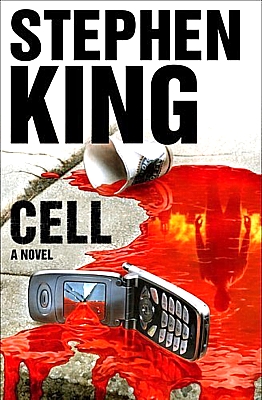
Clay's tight group soon meets other survivors, including the last surviving "normal" student (named Jordan) and teacher (Charles Ardai, who shares his name with the co-creator of Hard Case Crime Books, publisher of King's The Colorado Kid) at New Hampshire prep school Gaiten Academy. Through these characters, King theorizes on the intent and nature of The Pulse itself - what it is, where it came from, and who or what caused it. Here, the subtext of Cell begins to surface, as Jordan and the others directly reference the attacks of September 11, 2001. Could The Pulse have been a subtler - and arguably more insidious - form of terrorism? While King offers no concrete answers, the specter of 9/11 looms over the remainder of the novel, carrying over into several concurrent short stories that would later appear in King's Just After Sunset collection. (Cell's paperback cover subtly underscores this connection, showing the garish red display screen of a cell phone; the 911 under the cracks in the plastic can be read both as a call for help and as a punctuation of the novel's themes of terrorist threat.)
Jordan further hypothesizes that The Pulse erases humanity from the brains of those affected, leading to a deeper level of technological horror. King wonders if, at base, people are essentially sophisticated computers. If The Pulse can wipe humanity away in one stroke, how different are people from machines? This pessimistic theory allows for some optimism, however: if people can be "crashed," can they also be rebooted? This question - never quite answered - becomes essential as the novel races to its close.
Those affected by the Pulse - known eventually as "phone crazies" or simply "phoners" - swiftly develop psychic abilities, including telekinesis, levitation, and telepathy. These "wild talents" defined much of King's early work, especially in the novels Carrie, The Shining, The Dead Zone, and Firestarter, which are built around people gifted (or cursed) with them. While minor characters, like Pet Sematary's Ellie Creed or the Dark Tower's Susannah Dean, possessed some psychic abilities, it was only with the The Green Mile's John Coffey that King fully returned to this concept, later devoting much of the recent Dreamcatcher to a deeper exploration into the repercussions of special talents.
Here, Clay and his friends are haunted by a series of disturbing prophetic dreams, further strengthening Cell's connection to The Stand. Following their attack on a "flock" of phoners, the survivors' dreams feature a creature who comes to be known at The Raggedy Man, seemingly a figurehead for the phoners. While King attempts to draw The Raggedy Man as a compelling antagonist, unfortunately his appearance undercuts the mindless terror of the early portions of the book. By giving the phoners a leader, the unpredictable menace of the early potions of the book diminishes. Additionally, because Cell seems in many ways an echo of The Stand, comparisons between The Raggedy Man and Randall Flagg are inevitable. Unfortunately, Flagg has attained a mythic, almost legendary status in King's novels and among readers, making favorable comparisons nearly impossible.
However, while The Raggedy Man falls somewhat short of intentions, Cell remains a thoroughly readable and engaging novel, one of King's most fast-paced written under his own name (only Firestarter and the early Bachman novels approach the swiftness of the narrative). The title is one of King's more brilliant multiple-meaning names, indicating not only cell phones, but also Clay's resistance cell, and the concept that brain cells can be wiped and rebooted. Cell is also King's last book to utilize an ambiguous ending, concluding a series of novels - From a Buick 8, The Dark Tower, and The Colorado Kid chief among them - with inconclusive finales. While the lack of a concrete "ending" can be impactful, lack of closure can result in reader frustration; even King reported that, due to strong reader reaction, his screenplay adaptation for Cell concludes more traditionally. For better or for worse, King's exploration of this controversial technique has, ironically, ended.
2006 Review
Stephen King novels affect me in different ways. When I originally came to him, when I was twelve years old, it was after having seen Pet Semetery in the theater. My Dad, knowing I loved the film, picked me up a paperback copy at a local store, and the rest, as they say, is history.
So my first introduction to King was a need – perhaps very much an outgrowth of my teenaged psyche – for visceral, gory horror. I wanted kids coming back from the dead and cats from hell and ancient Indian burial grounds that held terrible secrets. This is what a childhood bred on 80’s horror taught me to expect: A Nightmare on Elm Street, Poltergeist, all that stuff: it underlined shock value above all else.
What I learned coming out of the novel version of Pet Semetery is that, while the visceral horror can exist and be interesting, it’s what goes on behind it that’s really important. The humanity that lurks in the characters, the poignancy of those characters’ often terrible journeys. The fact that those two things – the sharp, bloody horrors, and the literary satisfaction of a tale well told – could coexist stunned me. And it kept stunning me for quite some time Ö until I sort of forgot about it.
Somewhere in my neverending defense of King as a worthy literary author, I forgot that yes, he does on occasion write scary stories. It seems absurd to admit now, but starting in 1998 with Bag of Bones, my perception of King has been that of a literary author whose “horror” days were a thing of the past. He won an O. Henry Award, he won a National Book Award, and all of it sort of got me to the point of saying, “Look, everyone. This Stephen King guy really is important. He’s literary! You don’t have to like vampires or werewolves or haunted hotels to like King. What about The Shawshank Redemption? What about Stand By Me? That’s Stephen King!’ But the problem is, by trying to mollify the masses by presenting only a portion of King’s story was sloppy of me; irresponsible, even. Because King doesn’t just write “literary stories” and “scary stories”; he writes both, often at the same time, and it was wrong of me to forget that.
Cell helped me to remember.
At first, the concept of Cell comes across as a kind of ironic social commentary: cell phone users nation- and, maybe, world-wide are suddenly affected by something known as The Pulse, which turns the listeners into mindless, zombie-like creatures: primitive, aggressive, and brutally violent. The idea could have played itself out as farce – cell phone users as mindless zombies, sure. Ha-ha.
But King plays it straight, and it’s to his strength that he pulls it off so casually. The main thrust of the story concerns Clay Riddell, a graphic novel artist and writer who has just gotten his big break before the Pulse hits. He’s in downtown Boston, and the only things on his mind are presents for his son and his estranged wife, and an ice cream cone for himself.
When the Pulse hits, its result is swift and bloody. A proper woman in a business suit in line ahead of him at the ice cream stand goes ballistic, lurching forward to tear the ice cream vendor apart. In the nearby Boston Common, a man suddenly turns on his dog, attempting to bite its ear off. Small and large pockets of violence erupt seemingly out of nowhere, and now the only thing on Clay’s mind is: is his son safe?
Thus, the book – a short one, by King’s standards, only about 380 pages – opens up as sort of a travelogue, and Clay Riddell one of King’s many protagonists on a quest. From the outset, Clay befriends a man named Tom from nearby Malden, and a young girl named Alice, who both agree to journey with him to Maine (where else?) to find out whether his son has been affected by The Pulse. Along the way, they meet some new people, and begin to theorize about the nature of the Pulse itself. Was it a terrorist act, a more subtle yet more insidious attack than those of 9/11? Did The Pulse, as one character hypothesizes, erase humanity from the brains of those affected down to the most basic, most violent human core? Are people really like computers? And if everything can be stripped away, can they also be rebooted?
Cell – another terrific double- or triple-meaning title – starts off with mindless violence, but it doesn’t follow that path for long. As the story evolves into something more thoughtful than the opening might suggest, so too do the people affected by The Pulse: eventually known as “phoners,” they slowly but surely begin to evolve. And that evolution might turn out to be the worst outcome of all.
This book surprised and thrilled me, all the way through. This is King’s first regular release since From a Buick 8 – while I loved the Dark Tower novels, I was ready for a breather – and I had no idea what to expect. King makes good use of recent tragedies – not only the obvious 9/11 parallels, but also the horror of Hurricane Katrina – to subtly underscore the horror being played out here. In addition, he brings back some of his old parlor tricks, utilizing psionics like telekinesis, levitation, and telepathy as some of the “wild talents” Clay and his friends encounter as part of the phoners’ evolution. (There’s also a couple of neat sequences involving prophetic dreams that underline Cell’s connection to The Stand.) And King hasn’t lost his sense of humor: for nearly half a page, King rakes Michael Bolton over the coals, for no reason other than that he can. It’s a hilarious throwaway moment, the kind that King is so very good at.
The last few pages of Cell brought to mind my very first King literary experience, Pet Semetery. Unlike that book’s inevitably pessimistic conclusion, this one ends with a note of hope. Recently, King has been toying with inconclusive endings – From a Buick 8 and The Colorado Kid being two of them. This isn’t like that; it’s an ending like that of The Stand or The Dark Half – an ending that hopes the darkness is past, but has a little trouble believing it.
The final pages of this book are devoted to a preview of King’s upcoming novel, Lisey’s Story. By all accounts, this is going to be King at his most literary, and I for one am duly excited. My only fear is that, when people look back on King’s 2006 output, they’ll make the mistake I almost made and recognize Lisey’s as another of King’s triumphs, while Cell is just the necessary evil of a horror novel.
Cell doesn’t deserve that. It’s a fully-realized, well-written, character-driven narrative that is graceful even in its bloodletting. Cell is King at the top of his craft.