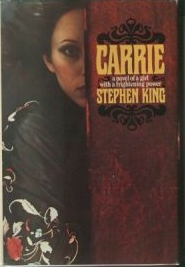
| Carrie |
|---|
|
| Publication Information
|
Carrie is Stephen King's Cinderella story. In the larger context, Carrie is the book that launched his career. The advance money for the book allowed him to quit teaching and focus on writing full-time. Following its publication in hardcover, Carrie would soon be adapted as a popular and critically lauded film by Brian DePalma, garnering two Academy Award nominations for stars Sissy Spacek and Piper Laurie. The film sparked interest in the book, sending the paperback printing shoot up the charts. "The movie made the book," King later mused, "and the book made me."
The novel Carrie, a tale of an outcast girl gifted (or afflicted) with the power of telekinesis, works as an update of the classic fairy tale. Carrie White is the tragic Cinderella character, a shy, socially awkward teenager at the lowest rungs of the high school caste system. When Carrie experiences her first menstrual period following gym class, the other girls - fulfilling the roles of the wicked stepsisters - torment her, cruelly asserting their superiority.
The cruelty doesn't end there: in place of a wicked stepmother, we find Carrie's biological mother, driven to the point of madness by an unbalanced personality and religious fanaticism. Just as the onset of Carrie's period seems to trigger her own dormant telekinetic abilities, it also heightens Margaret White's instability. The theme of a parent being threatened by a child's encroaching adulthood here is twisted and heightened to horrific extremes.
Sue Snell, acting as the fairy godmother, asks her boyfriend Tommy Ross to take Carrie to the prom, as a way of repenting for her role in tormenting Carrie. King's clever reimagining of Prince Charming and the ball yields some surprising results: when forced to accept Carrie even as a temporary member of their society, her classmates find her surprisingly easy to like. Carrie, bolstered by rebellion against her mother and acceptance of her abilities, proves to be charming and even funny. Here King underlines another truth of school society versus adult society: when given a chance, outcasts can blossom. King will return to this theme over and over in his fiction, most notably in It.
Indeed, Carrie introduces a number of themes and motifs that King will return to in the course of his fiction. Margaret White is a precursor to Vera Smith, Johnny Smith's mother in The Dead Zone; both parents believe their child's abilities are the work of the devil. Children with paranormal talents populate much of King's early work: Danny Torrence's psychic flashes, Ellie Creed's prophetic dreams, and Charlie McGee's pyrokinetic displays echo Carrie White's experimentation with her abilities. King's affinity for wholesale destruction of small towns begins here, as well: the events of the Black Prom prefigure the finales of It, Needful Things, Bag of Bones, and Under the Dome.
The central tragedy in Carrie stems from Carrie White's inherent personality. As her abilities make manifest, Carrie seems to willfully choose not to be a victim any longer. Her experiments in moving objects with her mind seem exciting rather than threatening; one gets the idea that, under other circumstances, Carrie would mature into adulthood with full control of her talents. This makes Carrie's final rampage more poignant. We are not dealing with simply a victim or a monster; in the course of his short novel, King manages to make Carrie White a fully-realized human. King wants us to sympathize with Carrie, rather than pity or fear her. It is no mistake that, rather than merely witnessing it, Sue Snell feels Carrie's death.
Interpolated throughout the text are excerpts - from newspapers, court transcriptions, eyewitness accounts - purporting to be real. Working with a cast of mostly young people in a genre that had yet to be critically accepted or understood, King subtly insists that Carrie's story be taken seriously. Though it has roots in fairy tales and the paranormal, Carrie emerges - as many of King's fictions do - as a story about ordinary people in extraordinary circumstances.
Carrie was not his first written novel (later Bachman books Rage and The Long Walk were written prior), but it served as most readers' first exposure to Stephen King. While the novel certainly isn't flawless (particularly jarring is King's early declaration that Carrie is telekinetic, going against the writer's dictum to show rather than tell), it remains a compelling story, populated with fascinating characters. As an introduction to King's long, varied, and productive career - and, more importantly, as a book in its own right - Carrie still works.