| Blaze |
|---|
|
|
Publication Information
|
King first discussed the book a quarter-century before its publication, in King's afterword to Different Seasons. Following the publication of Carrie, King presented his editor with two new manuscripts - Second Coming (which would eventually become 'Salem's Lot) and Blaze, the story of a mentally-challenged giant who decides to kidnap a child for ransom money. The first was a new kind of vampire novel, the second an Of Mice and Men pastiche. King's editor sighed and allowed as to how the vampire book was the better of the two, lamenting that King was going to get "typed" as a horror writer. King didn't seem to mind much, 'Salem's Lot was published, and Blaze got stuck in a trunk.
As King's career marched on, interest in all things King grew. There developed a cottage industry of books about King, and several early books - including Michael Collings's The Many Facets of Stephen King and George Beahm's seminal Stephen King Companion - discussed Blaze in greater detail. Much later, Stephen Spignesi's masterful The Lost Work of Stephen King devoted a whole chapter to Blaze, and Rocky Wood's Stephen King: Uncollected, Unpublished further whetted King enthusiasts' appetite for this long-unpublished book. Like other early King novels, The Aftermath and Sword in the Darkness, Blaze, it seemed, was going to be relegated to mythic, unread status forever.
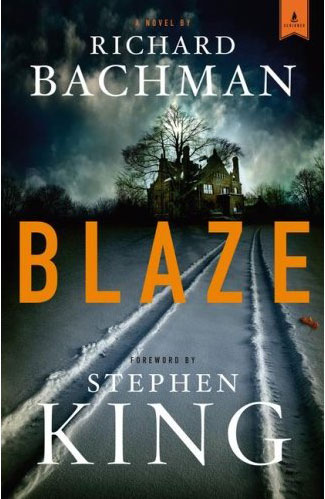
This held true until 2006, when King suddenly and surprisingly let it slip that Blaze, after thirty-five years, was going to be published. Further, he was considering it another "lost" Bachman book, in the same vein as The Regulators. The major difference was that, unlike The Regulators, Blaze really was a lost book. Some King fans bemoaned the decision to release it under the Bachman name, the primary complaint being that it seemed pointless to continue the Bachman name if everyone knows it's really King; any bookseller will tell you, however, that a good portion of King's less-ardent audience has no idea who Richard Bachman is. King explains himself in the "Full Disclosure" foreword, "The Bachman name on it because it's the last novel from 1966-1973, which was that gentleman's period of greatest productivity." Hedging its bets, King's publisher, Scribner, loudly advertised King's involvement. While the cover still lists Bachman's name as the author, it also promotes King's introduction, his name in the same massive font as Bachman's. (The cover of the paperback took no chances, stating it was by "Stephen King writing as Richard Bachman.")
Editing from his very early draft, King re-wrote Blaze in the noir style, utilizing "dry, flat tones" and leaving the time frame intentionally vague. King also reveals that he'd written using the tools of old noir writers, employing a typeface font and editing in pencil; these glimpses into King's writing process always illuminate the stories from which they spring. All these elements taken into consideration, Blaze would have the feel of the early Bachman novels, a similar style, a familiar structure. While not necessarily cozy experiences, the Bachman books are dark, disturbing, yet also thrilling. Blaze is no exception.
The story is unrelenting. True to his intentions, King has crafted an economical read, as quickly paced as the earliest Bachman novels. The author simply feels like those of these early books. In tone and speed, Blaze recalls the doomed march of The Long Walk; the more complex and tragic back story brings to mind Bart Dawes in Roadwork. The main narrative, which centers on the mentally damaged Blaze kidnapping a rich family's baby for ransom, works well, giving the novel a structure both engaging and propulsive. In a reversal from Rage's long look at Charlie Decker, however, the things that made Blaze a criminal are even more exciting than his current situation. A horrifying scene near the beginning of the novel reveals young Blaze as a quiet, bookish child, before his father throws him down the stairs three times for interrupting him watching TV. (It also underlines the dark presence of fathers in the Bachman books: every Bachman novel - including, arguably, The Regulators' Johnny Marinville - features a father figure whose abuse, indifference, or ineffectualness damages his children. Even Ben Richards, the most heroic father in the Bachman novels, starts off with a child who remains sick because Richards can't afford medicine.) This scene recalls/anticipates the opening pages in Rose Madder, as Norman beats Rosie into a miscarriage, then calmly tells her she can have another.
Blaze is that kind of tragedy; there's little actual hope to be found in these pages, so what we are left with is a suspicious sort of compassion. For all his misdeeds, Blaze isn't really a bad person. He was born into his large, unwieldy frame, and he was forced into a cramped, tormented life ... but inside that life, Blaze still finds the capacity for good. Some flashback scenes during which Blaze and a friend run away from their horrific boarding school for the weekend and take a trip to Boston are nearly heartbreaking. Seeing the world through Blaze's eyes is fascinating, because so often they are the eyes of the child (one can see in Blaze as the genesis of King's series of mentally-challenged adults, notably Tom Cullen from The Stand, John Coffey from The Green Mile, and Duddits Clavell, from Dreamcatcher).
A later sequence involving Blaze's stay at a working farm for the summer immediately makes the Of Mice & Men allusions more forceful, as were those of Dracula in 'Salem's Lot or Dr. Jeckyll & Mr. Hyde in The Dark Half. Never do these allusions, however, threaten obviousness, as did Dreamcatcher with its blatant (and textual) nods to Conrad's Heart of Darkness. It is at this working farm that Blaze offers its only real moments of hopefulness, before a coincidental tragedy in the tradition of Cujo befalls him. Blaze comes to believe that he has mostly run out of options before he turns to a life of crime, a motif running throughout the Bachman novels. Blaze's desperation echoes not only Charlie Decker and Bart Dawes, but also Ben Richards (The Running Man) and even Billy Halleck (Thinner). That Blaze is probably right might be the biggest heartbreak of all.
Most interesting in the main storyline are Blaze's relationship with the baby himself, and his relationship with his partner in crime, George Rackley. The reader knows that George has been dead for over three months when the book begins, but Blaze himself often forgets. King hints without really saying that George represents a part of Blaze that wasn't damaged in those long-ago falls, that somewhere underneath his mangled synapses, real intelligence is simmering. (Later, there's a vague hint that George actually might be a ghost, and that he and Blaze may have had some tenuous psychic connection ... but Blaze isn't a supernatural tale at its heart, and those vague hints are left vague.) That Blaze keeps returning to George's voice (a device King will use again in Roadwork) is telling. Blaze ends up falling in love with the baby he had intentioned to ransom, and comes to the conclusion he cannot let him go, just as he cannot let George go, even in death. On another level, Blaze may see the baby as a purer representation of himself, before his father damaged him.
Only a relative few have been able to see the original manuscript, so a detailed comparison of the changes made to the published novel is unfortunately impossible. What is known, though, is interesting: both Blaze's and George's names have been changed (Claiborne Blaisdell, Jr. - Blaze - became Clayton Blaisdell, Jr, likely to avoid comparisons to Dolores Claiborne; George Rockley is now George Rackley). Many of the early reports of Blaze from those who had read it stated that the details of the kidnapping, including leaving an infant alone for extended periods of time, were a bit far-fetched. If that was true of the initial drafts, the book may have been tightened up since; Blaze as it stands seems believable enough.
Of course, this being a Bachman book, a happy ending isn't really in the offing; the most hopeful of the Bachman novels, The Regulators, ends up with half its main cast gunned down. Happy endings aren't really the point in Bachman books. Against the reader's better judgment, Blaze comes across as a sympathetic, compassionate, and ultimately tragic character. By the end, readers may actually be rooting for the guy to get away, even though that would be the worst possible outcome, and even though Blaze's fate is quite plainly predestined. That's the beauty of Blaze: from page one, it's obvious that this is the story of a doomed man, but because both the character and the story surrounding him are so compelling, one is helpless to stop reading.